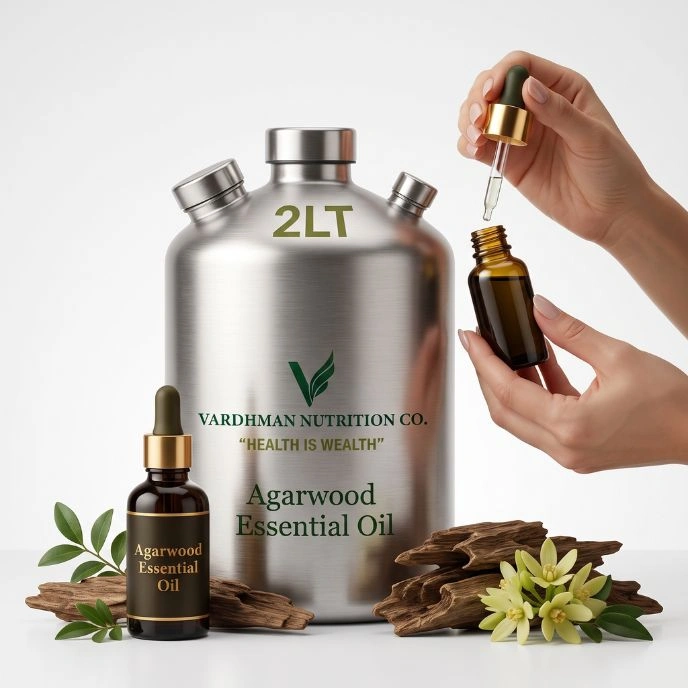
Agarwood Essential Oil Manufacturer, Bulk Supplier & Exporter from India
Premium Agarwood Essential Oil
Agarwood Essential Oil, also known as Agar Oil or Oud Oil, is a highly valued natural aromatic oil associated with resinous agarwood obtained from trees of the Aquilaria genus. It is particularly recognized for its deep, warm, woody, resinous, balsamic and complex fragrance character.
Unlike lighter aromatic oils, Agarwood Oil has a distinctive and sophisticated fragrance profile that makes it especially relevant to fine perfumery, luxury fragrances, aromatherapy, wellness products, incense and selected cosmetic formulations.
The unique character of Agarwood comes from resinous aromatic material developed within suitable agarwood. The quality, fragrance and composition of the resulting oil can vary according to botanical source, geographical origin, raw-material quality, processing method and production conditions.
Vardhman Nutrition Co. is an India-based Agarwood Essential Oil Manufacturer, Bulk Supplier and Exporter, serving international B2B buyers looking for natural aromatic ingredients from India.
We support commercial requirements from importers, wholesalers, distributors, fragrance companies, cosmetic manufacturers, aromatherapy businesses, private label companies and other professional buyers.
Our approach is focused on Bulk Agarwood Oil supply, Wholesale Agarwood Oil sourcing, suitable export packaging, technical documentation and international B2B trade.
Understanding Agarwood Essential Oil
Agarwood is a specialized aromatic botanical material associated with the Aquilaria genus. Under suitable natural conditions, resinous material can develop within the wood, producing the characteristic fragrance for which agarwood is internationally valued.
This resinous aromatic material is processed to obtain Agarwood Essential Oil through suitable extraction and distillation techniques.
The resulting oil is known for an aroma that can include:
- Deep woody notes
- Warm balsamic nuances
- Resinous character
- Earthy undertones
- Smoky impressions
- Sweet aromatic notes
- Rich oriental fragrance
- Complex and long-lasting character
Because fragrance characteristics can differ according to source and processing, professional buyers should evaluate the specific oil according to their intended application and required specifications.
Botanical and Product Information
| Product Parameter | Description |
|---|---|
| Common Name | Agarwood |
| Product Name | Agarwood Essential Oil |
| Alternative Names | Agar Oil, Oud Oil |
| Botanical Source | Aquilaria genus |
| Product Category | Natural Essential Oil |
| Raw Material | Aromatic Resinous Agarwood |
| Appearance | Light Yellow to Amber / Darker Shades |
| Aroma | Deep, Woody, Warm, Resinous and Balsamic |
| Consistency | May vary according to oil and processing characteristics |
| Main Applications | Perfumery, Fragrance, Aromatherapy, Cosmetics & Wellness |
| Supply Type | Bulk, Wholesale and B2B |
The exact appearance, aroma profile, composition and physical characteristics may vary according to raw material origin, processing conditions and individual batch specifications.
For commercial requirements, buyers can request relevant product specifications and technical documentation before confirming an order.
Distinctive Aroma of Agarwood Oil
One of the most important characteristics of Agarwood Essential Oil is its highly distinctive fragrance.
It is generally associated with a rich, deep, woody and resinous aroma, often accompanied by warm, balsamic and slightly sweet nuances.
This complex aromatic character makes Agarwood Oil particularly useful in fragrance compositions where depth and sophistication are required.
- Rich and luxurious
- Deep and woody
- Warm and balsamic
- Resinous and earthy
- Complex and refined
- Oriental in character
- Long-lasting in suitable compositions
- Suitable as a base or supporting fragrance note
For perfume manufacturers, the exact fragrance profile is an important consideration because Agarwood Oils from different botanical sources or production conditions can display noticeable aromatic differences.
Commercial Applications of Agarwood Essential Oil
Agarwood Essential Oil is a specialized botanical ingredient used across several premium product categories.
Fine Perfumery
Agarwood Oil is particularly valued in premium and luxury perfume formulations. Its deep woody-resinous character can add complexity, warmth and depth to fragrance compositions.
Fragrance Manufacturing
Fragrance companies can use Agarwood Oil in selected aromatic blends, oriental fragrance compositions and premium fragrance products.
Aromatherapy
Its rich aroma makes Agarwood Essential Oil suitable for selected aromatherapy and wellness formulations designed around relaxation and a calming aromatic environment.
Cosmetics
The oil can be incorporated into suitable cosmetic and personal-care formulations where its distinctive fragrance is desired.
Personal Care
Agarwood Oil may be used in selected soaps, body-care products, massage oils and premium personal-care formulations.
Incense Products
Its rich aromatic character makes it suitable for selected incense and traditional aromatic products.
Spa and Wellness
The deep fragrance of Agarwood Oil can be incorporated into massage and spa-related aromatic formulations.
Private Label Products
Private label businesses can source Agarwood Oil for branded fragrance, wellness, cosmetic or personal-care product ranges, subject to formulation and regulatory requirements.
Agarwood Essential Oil for Fine Perfumery
Agarwood Essential Oil for Fine Perfumery is one of the important commercial applications of this botanical oil.
Its deep and complex aromatic character can provide an important foundation for sophisticated perfume compositions.
Perfumers may use Agarwood Oil to develop:
- Luxury perfumes
- Oriental fragrance compositions
- Woody perfumes
- Resinous fragrance blends
- Premium attars
- Botanical fragrance products
- High-end aromatic formulations
The oil can also be blended with other suitable aromatic ingredients to create customized fragrance profiles.
Because fragrance requirements differ from one perfume manufacturer to another, buyers should specify the desired aromatic character, quantity, application and technical requirements when making a commercial enquiry.
Agarwood Oil for Fragrance Manufacturers
Fragrance manufacturers often require specialized natural ingredients capable of contributing depth and character to finished compositions.
The rich fragrance profile of Agarwood Oil makes it suitable for selected:
- Perfume bases
- Fragrance blends
- Oriental compositions
- Woody formulations
- Natural fragrance products
- Premium aromatic products
- Personal-care fragrances
- Incense fragrances
Its complex aroma can work particularly well in fragrance compositions where a warm, woody and resinous character is required.
For commercial fragrance production, the recommended level of use should be determined according to the specific formulation and applicable regulatory requirements.
Agarwood Essential Oil for Aromatherapy and Wellness
The rich aromatic profile of Natural Agarwood Essential Oil makes it a popular ingredient for selected wellness and aromatherapy applications.
It can be incorporated into:
- Aromatherapy blends
- Diffuser formulations
- Massage oils
- Spa products
- Meditation-related aromatic products
- Wellness formulations
- Relaxation-oriented fragrance blends
- Premium aromatic products
Agarwood's deep fragrance can help create a warm and peaceful aromatic atmosphere.
Businesses developing wellness products can discuss bulk sourcing requirements based on their formulation, quantity and destination market.
Agarwood Oil for Cosmetics and Personal Care
Agarwood Essential Oil can be used as a botanical aromatic ingredient in suitable cosmetic and personal-care formulations.
Potential product categories include:
- Premium skincare products
- Body-care formulations
- Massage oils
- Soaps
- Bath products
- Hair-care formulations
- Natural personal-care products
- Fragrance-oriented cosmetics
- Luxury wellness products
Its rich fragrance profile can provide a distinctive aromatic identity to premium personal-care products.
For cosmetic manufacturers, the suitability and concentration of Agarwood Oil should be evaluated according to the finished formulation, intended use and applicable regulations.
Agarwood Oil for Incense and Traditional Aromatic Products
Agarwood has a long association with traditional aromatic products and incense.
Agarwood Essential Oil may be considered for suitable:
- Incense products
- Dhoop formulations
- Aromatic blends
- Traditional fragrance products
- Religious and cultural aromatic products
- Premium incense compositions
Its warm and resinous aroma makes it particularly valuable in fragrance products where a deep and distinctive aromatic character is required.
Natural Constituents of Agarwood Essential Oil
The chemical profile of Agarwood Oil is complex and may vary according to botanical source, resin formation, geographical origin, extraction method and other production conditions.
Naturally occurring aromatic compounds associated with Agarwood Oils may include:
- Agarospirol
- Jinkoh-eremol
- Oxo-agarospirol
- Eudesmol compounds
- Agarofuran derivatives
- Sesquiterpenes
- Chromone-related compounds
- Valencene
- Guaiol
- Aromadendrane-related compounds
- Other naturally occurring aromatic resin compounds
These compounds contribute to the characteristic fragrance and chemical profile of Agarwood Essential Oil.
For professional B2B buyers, GC-MS analysis can provide information about the volatile compounds present in a specific batch.
Buyers requiring defined chemical specifications should request batch-specific technical documentation before purchase.
Agarwood Essential Oil Quality Considerations
Quality evaluation is particularly important when sourcing premium botanical oils.
For Agarwood Essential Oil, commercial buyers may consider:
- Botanical source
- Raw-material quality
- Resinous material
- Geographical origin
- Aroma profile
- Appearance
- Consistency
- Chemical composition
- Extraction method
- Batch characteristics
- Packaging
- Storage conditions
- Technical documentation
The aroma and composition can differ according to the source and processing method. Therefore, a clear product specification is important for manufacturers using the oil in repeat formulations.
Vardhman Nutrition Co. supports commercial buyers by discussing product specifications and technical documentation according to individual sourcing requirements.
Agarwood Essential Oil Processing and Extraction
The production of Agarwood Essential Oil involves the processing of suitable aromatic agarwood material through extraction and distillation.
Depending on the production process, suitable methods may include steam distillation and other appropriate extraction techniques.
Step 1: Selection of Aromatic Raw Material
Suitable agarwood material is selected according to the intended oil quality and processing requirements.
Step 2: Preparation of Wood
The selected material is prepared into suitable pieces or smaller particles to facilitate processing.
Step 3: Pre-Processing
Depending on the production method, the material may undergo controlled preparation before distillation.
Step 4: Extraction or Distillation
The prepared aromatic material is processed using an appropriate extraction or distillation system.
Step 5: Release of Volatile Compounds
Controlled heat, steam or another suitable extraction medium helps release aromatic constituents from the resinous material.
Step 6: Condensation
In steam-based processes, aromatic vapours are cooled through a condenser to produce a liquid mixture.
Step 7: Oil Separation
The essential oil is separated from the water phase using suitable separation equipment.
Step 8: Filtration
The extracted oil can be filtered to obtain a clean finished product according to applicable specifications.
Step 9: Quality Evaluation
The finished oil can be evaluated for appearance, aroma, physical characteristics and other applicable quality parameters.
Step 10: Packaging
The finished Agarwood Essential Oil is packed into suitable containers designed for storage and transportation.
Bulk Agarwood Essential Oil Supplier from India
Vardhman Nutrition Co. supplies Bulk Agarwood Essential Oil for international B2B customers.
Our bulk supply model is suitable for businesses purchasing natural aromatic oils for:
- Manufacturing
- Wholesale distribution
- Perfume production
- Fragrance formulation
- Aromatherapy products
- Cosmetic manufacturing
- Personal-care products
- Incense production
- Private label products
- Commercial botanical formulations
International buyers may require different quantities and packaging formats depending on their production requirements.
Businesses looking to buy Agarwood Essential Oil in bulk from India can share their required quantity, application, packaging preference and destination country for commercial discussion.
Agarwood Essential Oil Manufacturer and Exporter from India
Vardhman Nutrition Co. is an India-based Agarwood Essential Oil Manufacturer, Supplier and Exporter focused on international B2B sourcing.
We support overseas businesses sourcing natural essential oils and botanical aromatic ingredients from India.
Our commercial supply approach is suitable for buyers requiring:
- Bulk Agarwood Oil
- Wholesale Agarwood Essential Oil
- Natural Agarwood Oil
- Fragrance applications
- Fine perfumery applications
- Aromatherapy applications
- Cosmetic applications
- Private label supply
- Export packaging
- Technical documentation
We support B2B sourcing requirements for international destinations including the USA, UK, Europe, Germany, UAE, Australia, South Korea and other global markets.
Private Label Agarwood Essential Oil
Private label companies may require specialized botanical oils for their own branded products.
Depending on the project, Agarwood Oil can be considered for private label ranges such as:
- Premium perfumes
- Natural fragrance products
- Aromatherapy oils
- Wellness products
- Massage oils
- Cosmetic products
- Personal-care products
- Incense products
Private Label Enquiry Information
- Required quantity
- Packaging format
- Label requirements
- Product specifications
- Intended application
- Destination country
- Technical documentation requirements
Supply feasibility can be evaluated according to the individual project.
Agarwood Essential Oil Export Packaging
Suitable packaging plays an important role in protecting essential oils during storage, handling and international transportation.
Depending on order quantity and customer requirements, packaging options may include:
- Aluminium bottles
- Aluminium containers
- Export-grade drums
- Bulk industrial packaging
- Customized packaging
Packaging requirements can be discussed according to order quantity, destination country, transportation method and customer requirements.
Specific packaging formats should be confirmed during the commercial order discussion.
Technical Documents for Agarwood Oil Buyers
Professional international buyers may require technical information before approving a natural essential oil for manufacturing or distribution.
Depending on product and batch requirements, relevant documentation may include:
- Certificate of Analysis (COA)
- GC-MS Report
- Safety Data Sheet (SDS/MSDS)
- Technical Data Sheet (TDS)
- Allergen Statement
- IFRA-related documentation, where applicable
- Other applicable product or export documents
Document availability depends on the specific product, batch, intended application and buyer requirements.
Storage of Agarwood Essential Oil
Correct storage can help preserve the quality and aromatic characteristics of Agarwood Essential Oil.
- Store in a cool and dry location.
- Protect the oil from direct sunlight.
- Avoid excessive heat.
- Keep containers tightly closed.
- Minimize prolonged exposure to air.
- Protect from excessive moisture.
- Use suitable containers for essential oil storage.
- Follow batch-specific storage recommendations.
For bulk quantities, appropriate storage throughout the supply chain is particularly important.
Shelf Life of Agarwood Essential Oil
The shelf life of Agarwood Essential Oil can vary according to oil composition, packaging and storage conditions.
Factors that may affect product stability include:
- Oil composition
- Packaging material
- Storage temperature
- Light exposure
- Oxygen exposure
- Moisture
- Container quality
- Handling practices
Because natural essential oils can change over time, commercial users should follow the manufacturer's recommended storage and shelf-life information for the particular product and batch.
Why Choose Vardhman Nutrition Co. for Agarwood Essential Oil?
Selecting the right supplier is important when sourcing specialized botanical oils for international manufacturing and distribution.
Vardhman Nutrition Co. offers an export-focused B2B supply approach for Agarwood Essential Oil.
Key Advantages
- India-based Agarwood Essential Oil Manufacturer
- Bulk Agarwood Oil Supplier
- Wholesale B2B supply
- Natural botanical oil sourcing
- International export focus
- Support for importers and distributors
- Supply for perfume manufacturers
- Support for fragrance companies
- Cosmetic and personal-care applications
- Aromatherapy and wellness applications
- Private label and OEM requirements
- Export packaging solutions
- Technical documentation support
- International shipment coordination
- Long-term B2B sourcing relationships
Our focus is to support professional buyers looking for a dependable source of Natural Agarwood Essential Oil from India.
Buy Agarwood Essential Oil in Bulk from India
If your company is looking to buy Agarwood Essential Oil in bulk from India, you can contact Vardhman Nutrition Co. with your commercial requirement.
We support enquiries from:
- International importers
- Essential oil wholesalers
- Distributors
- Perfume manufacturers
- Fragrance companies
- Cosmetic manufacturers
- Aromatherapy businesses
- Wellness product manufacturers
- Incense product companies
- Private label businesses
- Other B2B buyers
Information Required for a Quotation
- Required quantity
- Intended application
- Product specifications
- Packaging requirements
- Destination country
- Technical documentation requirements
- Sample requirement, if applicable
Providing these details allows the sourcing requirement to be evaluated more efficiently.
Frequently Asked Questions About Agarwood Essential Oil
What is Agarwood Essential Oil?
Agarwood Essential Oil is a natural aromatic oil obtained from suitable aromatic agarwood associated with trees of the Aquilaria genus. It is particularly recognized for its deep, woody, warm, resinous and complex fragrance.
What is another name for Agarwood Essential Oil?
Agarwood Essential Oil is also commonly referred to as Agar Oil or Oud Oil.
What is Agarwood Oil used for?
It can be used in suitable fine perfumery, fragrance, aromatherapy, wellness, cosmetics, personal care and incense-related applications.
What does Agarwood Essential Oil smell like?
Agarwood Oil is generally associated with a deep, warm, woody, resinous and balsamic aroma. Its exact fragrance can vary according to botanical source and processing.
Is Agarwood Essential Oil available in bulk?
Yes. Bulk and wholesale supply can be discussed according to product availability, required quantity, specifications, packaging and destination-market requirements.
Where can I buy Agarwood Essential Oil in bulk from India?
International B2B buyers can contact Vardhman Nutrition Co. for commercial sourcing requirements for Agarwood Essential Oil from India.
Do you supply Agarwood Oil internationally?
Yes. Vardhman Nutrition Co. focuses on international B2B sourcing and export requirements for overseas buyers.
Can Agarwood Essential Oil be used in perfumes?
Yes. Agarwood Oil is particularly valued for selected fine-perfumery and fragrance applications because of its deep and complex aromatic profile.
Can Agarwood Oil be used in cosmetics?
It can be considered for suitable cosmetic and personal-care formulations. The appropriate concentration and regulatory requirements should be evaluated according to the finished product and destination market.
Do you provide COA and GC-MS?
Relevant technical documentation such as COA, GC-MS, SDS/MSDS and TDS may be available depending on the specific product, batch and customer requirements.
Can you supply private label Agarwood Essential Oil?
Private label, OEM and customized supply requirements can be discussed based on quantity, packaging, labeling, specifications and destination market.
What information is needed for an Agarwood Oil quotation?
Buyers can provide the required quantity, intended application, product specifications, packaging preference and destination country. Sample and technical-document requirements can also be shared.
Contact Agarwood Essential Oil Manufacturer from India
Looking for an Agarwood Essential Oil Manufacturer, Bulk Supplier and Exporter from India?
Vardhman Nutrition Co. supplies Natural Agarwood Essential Oil for international B2B customers involved in fine perfumery, fragrance manufacturing, cosmetics, personal care, aromatherapy, wellness, incense and other suitable commercial applications.
Whether you are an importer, wholesaler, distributor, perfume manufacturer, fragrance company, cosmetic manufacturer or private label business, you can contact us with your Agarwood Oil requirement.
For a Commercial Enquiry, Share:
- Product: Agarwood Essential Oil
- Required Quantity
- Intended Application
- Destination Country
- Packaging Preference
- Product Specifications
- Technical Documentation Requirements
- Sample Requirement, if applicable
We can evaluate your requirement and discuss suitable bulk Agarwood Essential Oil supply and export options.
Choose Vardhman Nutrition Co. for Bulk Agarwood Essential Oil
Vardhman Nutrition Co. is an India-based Agarwood Essential Oil Manufacturer, Supplier and Exporter focused on international B2B sourcing.
We support businesses looking for Pure Agarwood Essential Oil, Natural Agarwood Oil, Bulk Agarwood Essential Oil, Wholesale Agarwood Oil and Private Label Agarwood Essential Oil from India.
Contact Vardhman Nutrition Co. today for Agarwood Essential Oil bulk supply, wholesale enquiries and international export requirements.










.webp)
.webp)
.webp)

.webp)