Palmarosa Essential Oil Manufacturer, Bulk Supplier & Exporter from India
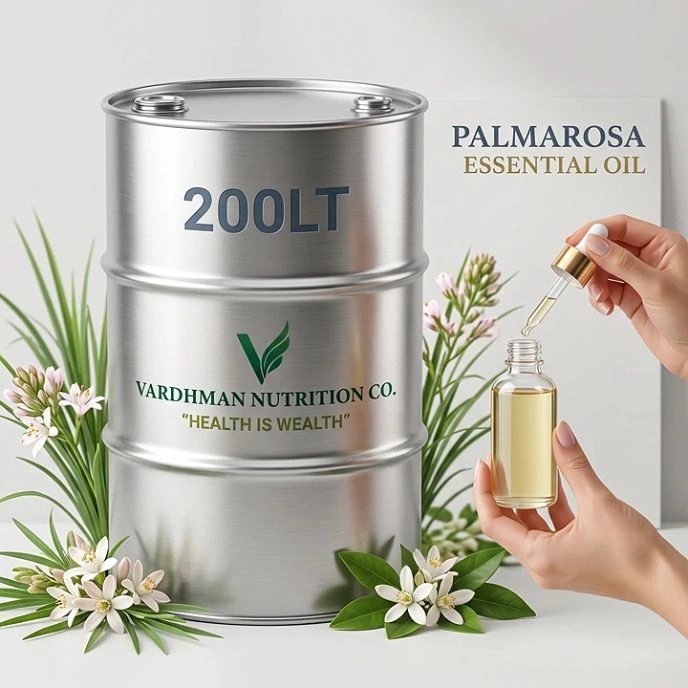
Vardhman Nutrition Co. is an India-based Palmarosa Essential Oil Manufacturer, Bulk Supplier and Exporter providing natural and steam-distilled Palmarosa Oil for international B2B markets. We supply Palmarosa Essential Oil in bulk quantities to importers, wholesalers, distributors, cosmetic manufacturers, personal care companies, aromatherapy brands, fragrance businesses and private label companies.
Palmarosa Essential Oil is valued for its distinctive sweet, floral and rose-like aroma and its suitability for a wide range of cosmetic, personal care, fragrance, wellness and industrial formulations. Its naturally occurring geraniol-rich profile makes it an important botanical ingredient for manufacturers looking for a versatile aromatic oil for commercial product development.
As a bulk supplier from India, Vardhman Nutrition Co. focuses on consistent sourcing, quality-oriented processing, export-ready packaging and reliable B2B supply. Our products are intended for commercial and manufacturing applications rather than domestic retail requirements.
What Is Palmarosa Essential Oil?
Palmarosa Essential Oil is an aromatic botanical oil obtained from Cymbopogon martinii, a fragrant grass belonging to the Poaceae family. The plant is cultivated in several parts of South Asia, while India is recognized as an important source of Palmarosa Oil.
The oil is mainly produced through steam distillation of the aromatic grass and flowering portions of the plant. It has a characteristic sweet, fresh, floral and rosy fragrance that makes it useful in perfumery, cosmetics, soaps, personal care products, aromatherapy blends and home fragrance formulations.
Because of its rose-like aromatic character, Palmarosa is sometimes associated with geranium-type fragrance profiles and is commercially appreciated as a natural botanical ingredient for fragrance and personal care applications.
For B2B manufacturers, the value of Palmarosa Oil lies in its combination of aromatic appeal, formulation versatility and compatibility with various product categories.
Botanical Source of Palmarosa Oil
The botanical name of Palmarosa is Cymbopogon martinii. It belongs to the Poaceae family and grows as a tall aromatic grass.
Typical botanical characteristics include:
- Slender green leaves
- Aromatic grass structure
- Flowering tops containing valuable volatile compounds
- Height that may reach approximately 1.5–3 metres
- Strong natural fragrance
- Cultivation across parts of India and other South Asian regions
The botanical material is harvested at a suitable stage of maturity before being processed through steam distillation. Proper harvesting and handling are important for obtaining an aromatic oil with a desirable fragrance profile.
Why Palmarosa Essential Oil Has a Rose-Like Aroma
One of the most recognizable characteristics of Palmarosa Oil is its soft, sweet and floral aroma with a noticeable rosy character.
Its fragrance profile is one of the reasons the oil is widely considered for:
- Fine fragrance formulations
- Perfume bases
- Soaps and body products
- Cosmetic formulations
- Natural deodorants
- Aromatherapy blends
- Room fragrance products
- Incense and agarbatti
- Personal care products
The exact aroma can vary according to botanical material, cultivation conditions, harvest stage, distillation parameters and storage conditions.
Geraniol-Rich Palmarosa Essential Oil
Palmarosa Essential Oil naturally contains geraniol, an aromatic compound that contributes significantly to its characteristic floral and rosy fragrance.
The supplied source material describes Palmarosa Oil as having a high geraniol content, commonly around 70–85%, although the actual composition may vary depending on raw material and processing conditions.
Other naturally occurring constituents may include geranyl acetate, linalool, citronellol, farnesol, myrcene, limonene, citral, nerol and other aromatic compounds.
For commercial buyers, the exact composition should be evaluated according to the relevant batch specification and available technical documentation.
Steam Distilled Palmarosa Essential Oil
Vardhman Nutrition Co. supplies steam-distilled Palmarosa Essential Oil produced from selected aromatic botanical material.
Steam distillation is a commonly used method for recovering volatile aromatic compounds from plant material. During the process, steam passes through the prepared botanical material and carries volatile components into a condenser. The condensed material is then separated to obtain the essential oil.
A controlled distillation process can help maintain the characteristic aromatic properties of the botanical material while supporting consistent commercial quality.
Palmarosa Essential Oil Extraction Process
The quality of an essential oil begins with the quality of its botanical raw material. A typical Palmarosa Oil extraction process involves several stages.
1. Selection of Botanical Material
Suitable Palmarosa grass and flowering material are selected according to quality requirements.
2. Harvesting
The plant material is harvested at an appropriate stage when the aromatic constituents are suitable for processing.
3. Cleaning
Foreign materials, unwanted plant matter and visible impurities are removed.
4. Preparation
The botanical material may be cut or prepared to support efficient steam contact during distillation.
5. Loading
Prepared Palmarosa material is placed inside the distillation unit.
6. Steam Distillation
Steam is introduced into the distillation chamber. Heat and steam help release volatile aromatic compounds from the plant material.
7. Condensation
The vapour containing the volatile components is cooled through a condenser and converted into a liquid mixture.
8. Oil Separation
The essential oil is separated from the condensed water phase.
9. Filtration
The recovered oil may undergo filtration to remove unwanted suspended matter.
10. Quality Evaluation
The finished oil is evaluated according to applicable product specifications and quality requirements.
11. Packaging and Storage
The finished Palmarosa Essential Oil is filled into suitable containers and stored under appropriate conditions until shipment.
Physical Characteristics of Palmarosa Essential Oil
| Property | Typical Description |
|---|---|
| Botanical Name | Cymbopogon martinii |
| Plant Family | Poaceae |
| Extraction Method | Steam Distillation |
| Appearance | Pale yellow to nearly transparent liquid |
| Aroma | Sweet, floral, fresh and rose-like |
| Main Aromatic Component | Geraniol-rich profile |
| Solubility | Suitable for blending with carrier oils and alcohol-based systems |
| Volatility | Moderate |
| Application | Cosmetics, perfumery, personal care, aromatherapy and fragrance |
| Commercial Form | Bulk essential oil |
The exact physical and chemical specifications can vary by batch and should be confirmed through product documentation.
Natural Constituents of Palmarosa Essential Oil
Palmarosa Oil contains a naturally occurring combination of aromatic compounds. Geraniol is one of its principal constituents, while several other compounds contribute to its overall fragrance character.
Important naturally occurring constituents may include:
- Geraniol
- Geranyl Acetate
- Linalool
- Citronellol
- Farnesol
- Myrcene
- Limonene
- Citral
- Nerol
- Beta-Caryophyllene
- Terpineol
- Ocimene
- Dipentene
The concentration of individual constituents can vary depending on botanical origin, harvesting conditions, processing method and batch characteristics.
For industrial buyers requiring detailed composition information, batch-specific analytical documentation can be requested.
Palmarosa Essential Oil for Perfumery
Palmarosa Oil is an attractive botanical ingredient for fragrance manufacturers because of its sweet floral and rosy aroma.
It can be considered for:
- Perfume compositions
- Fragrance concentrates
- Floral accords
- Natural fragrance blends
- Soap fragrances
- Body care fragrances
- Home fragrance products
- Incense formulations
Its aromatic profile can be combined with other essential oils and fragrance ingredients depending on the desired final formulation.
Palmarosa Essential Oil for Cosmetics
Cosmetic manufacturers use botanical oils as functional and aromatic ingredients in a variety of formulations.
Palmarosa Essential Oil can be incorporated into products such as:
- Creams
- Lotions
- Facial oils
- Body oils
- Cleansing products
- Serums
- Bath products
- Natural personal care formulations
For cosmetic applications, the oil should be incorporated according to the manufacturer's formulation requirements and applicable safety guidelines.
Palmarosa Oil for Skin Care Formulations
Palmarosa Oil is often selected for skin-care formulations because of its floral aroma and its compatibility with botanical and natural personal care concepts.
It can be considered for:
- Facial oil blends
- Body care products
- Moisturizing formulations
- Botanical creams
- Natural skin-care products
- Spa formulations
- Aromatic massage blends
Palmarosa is also commonly associated with formulations designed around skin freshness and a balanced personal-care experience.
Manufacturers should determine the appropriate concentration based on the intended product, formulation type and applicable regulations.
Palmarosa Oil for Hair Care Products
The aromatic profile of Palmarosa Essential Oil also makes it suitable for selected hair-care and scalp-care formulations.
Potential commercial applications include:
- Hair oils
- Shampoos
- Conditioners
- Scalp-care products
- Botanical hair blends
- Herbal personal-care formulations
- Hair spa products
It can be blended with suitable carrier oils or incorporated into finished formulations according to product requirements.
Palmarosa Essential Oil for Aromatherapy
Palmarosa Oil is widely appreciated in aromatherapy and wellness formulations for its sweet floral fragrance.
It may be used in:
- Diffuser blends
- Aromatherapy oils
- Massage blends
- Meditation products
- Spa formulations
- Relaxation-focused fragrance products
- Wellness blends
Its soft floral aroma can contribute to an inviting and calming fragrance environment.
For aromatherapy applications, appropriate dilution and responsible handling are important.
Palmarosa Oil for Soap and Bath Products
Soap and bath product manufacturers can use Palmarosa Essential Oil as a natural aromatic ingredient.
Commercial applications include:
- Handmade soaps
- Natural soaps
- Bath oils
- Bath salts
- Shower products
- Body washes
- Bath blends
- Spa products
Its rose-like fragrance can add a distinctive botanical character to personal cleansing and bath formulations.
Palmarosa Essential Oil for Natural Deodorant Products
The floral aroma of Palmarosa makes it a suitable consideration for natural deodorant and body-care formulations.
It can be used in:
- Natural deodorant blends
- Body sprays
- Fragrance oils
- Botanical body-care products
- Personal hygiene formulations
Manufacturers can combine it with other suitable aromatic ingredients to create customized fragrance profiles.
Palmarosa Oil for Home Fragrance and Cleaning Products
Beyond personal care, Palmarosa Oil can be considered for various household and environmental fragrance applications.
These include:
- Room fresheners
- Natural fragrance sprays
- Cleaning formulations
- Diffuser blends
- Household fragrance products
- Botanical cleaning concepts
Its fresh floral character can help create a pleasant aromatic profile in home-care products.
Palmarosa Essential Oil for Incense and Agarbatti
Palmarosa Essential Oil is also relevant to fragrance-based products such as incense and agarbatti.
It can contribute floral and rosy notes to:
- Agarbatti
- Incense sticks
- Fragrance blends
- Dhoop products
- Meditation fragrances
- Spiritual and wellness fragrance products
Its aroma works well in fragrance combinations developed for traditional and contemporary incense products.
Palmarosa Oil in Natural and Herbal Products
The growing interest in botanical ingredients has created demand for natural aromatic oils across multiple product categories.
Palmarosa Oil may be considered by manufacturers working in:
- Herbal personal care
- Natural cosmetics
- Wellness products
- Spa products
- Aromatherapy
- Botanical fragrance
- Organic personal care
- Natural household products
Its versatility allows manufacturers to develop different product concepts around a single botanical ingredient.
Research Interest in Palmarosa Essential Oil
Palmarosa Essential Oil has attracted research interest because of its naturally occurring aromatic compounds and potential biological properties.
Research areas associated with Palmarosa and its constituents include:
- Antibacterial activity
- Antifungal activity
- Antioxidant potential
- Aromatic and wellness applications
- Insect-repellent research
- Agricultural pest-management studies
- Cosmetic formulation research
Research findings should not automatically be interpreted as medical claims for finished commercial products. Manufacturers should follow applicable regulatory requirements when making product claims.
Key Features of Palmarosa Essential Oil
Palmarosa Essential Oil offers several characteristics that make it commercially useful:
- Natural botanical origin
- Steam-distilled production
- Sweet floral and rosy fragrance
- Geraniol-rich aromatic profile
- Suitable for fragrance applications
- Useful for cosmetic and personal care formulations
- Suitable for aromatherapy and wellness products
- Applicable to soap and bath products
- Useful in incense and agarbatti
- Suitable for bulk B2B supply
- Available for international export requirements
Bulk Palmarosa Essential Oil Supplier
Vardhman Nutrition Co. supplies Palmarosa Essential Oil for bulk and wholesale B2B requirements.
Our target customers include:
- Essential oil importers
- International distributors
- Wholesalers
- Cosmetic manufacturers
- Personal care manufacturers
- Aromatherapy companies
- Fragrance manufacturers
- Soap manufacturers
- Private label businesses
- Natural product brands
- Wellness product companies
Bulk procurement allows manufacturers and distributors to source botanical oil according to their commercial requirements rather than relying on small retail quantities.
Wholesale Palmarosa Oil from India
India is an important source of botanical raw materials and aromatic oils. Our Palmarosa Oil supply is structured for international buyers seeking reliable sourcing from India.
Wholesale buyers can discuss requirements related to:
- Required quantity
- Packaging format
- Product specifications
- Application
- Documentation
- Destination country
- Shipping requirements
This approach allows the product supply to be aligned with the buyer's commercial and regulatory requirements.
Palmarosa Essential Oil Manufacturer in India
As a manufacturer and exporter based in India, Vardhman Nutrition Co. focuses on supplying botanical essential oils to international B2B customers.
Our approach emphasizes:
- Consistent raw material sourcing
- Controlled processing
- Quality-oriented handling
- Suitable packaging
- Batch-level product information
- Export-oriented supply
- Reliable communication
- Long-term B2B relationships
We work with buyers looking for dependable botanical ingredient sourcing for manufacturing and distribution.
Palmarosa Essential Oil Exporter from India
Vardhman Nutrition Co. supplies Palmarosa Essential Oil for international markets, including buyers in the USA, UK, Europe, Germany, UAE, Australia and South Korea, subject to applicable import and regulatory requirements.
Our export-oriented supply model is designed for importers, distributors, manufacturers and commercial buyers who require Palmarosa Oil in bulk quantities.
We can coordinate product requirements, packaging preferences and technical documentation according to the needs of international customers.
Palmarosa Essential Oil for Importers and Distributors
Importers and distributors often require products that can be incorporated into their existing supply chains.
We provide Palmarosa Essential Oil for businesses involved in:
- Ingredient distribution
- Essential oil wholesale
- Cosmetic raw material supply
- Aromatherapy product supply
- Natural ingredient distribution
- Fragrance ingredient sourcing
Bulk buyers can communicate their target quantity, destination, packaging requirements and product application before placing an order.
Private Label Palmarosa Essential Oil
Businesses developing their own essential oil or wellness brand can discuss private label and OEM supply requirements.
Private label projects may involve:
- Product sourcing
- Bulk essential oil supply
- Packaging selection
- Label requirements
- Commercial quantities
- Customized presentation
- Export documentation
Private label requirements should be discussed in advance so that product specifications, packaging and labeling can be aligned with the intended market.
Export Packaging for Palmarosa Essential Oil
Proper packaging is important for maintaining essential oil quality during storage and transportation.
Depending on quantity and shipping requirements, suitable packaging solutions may include:
- Small commercial containers
- Aluminium containers
- HDPE containers where appropriate
- Drums
- Bulk export packaging
Packaging selection depends on order quantity, transportation method, destination requirements and customer specifications.
The containers should be properly sealed and protected from excessive heat, moisture and direct sunlight.
Quality Control and Technical Documentation
For international B2B buyers, product quality and documentation are important parts of the purchasing process.
Depending on the product and order requirements, buyers may request documentation such as:
- Certificate of Analysis (COA)
- Product specification
- Batch information
- GC-MS analysis where applicable
- Safety-related documentation
- Packing information
- Commercial export documents
Technical documents should be evaluated according to the buyer's application and destination-market requirements.
Vardhman Nutrition Co. focuses on providing commercially suitable Palmarosa Essential Oil with documentation support according to applicable product and order requirements.
Storage Guidelines for Palmarosa Essential Oil
Correct storage helps maintain the aromatic characteristics of essential oils over time.
Recommended storage practices include:
- Store in a cool and dry location
- Keep away from direct sunlight
- Protect from excessive heat
- Keep containers tightly closed
- Minimize unnecessary exposure to air
- Protect from moisture
- Use suitable dark or protective containers
- Avoid repeated opening where possible
- Keep away from children and pets
A storage temperature around 15–25°C can be suitable depending on the product specification and environmental conditions.
Palmarosa Essential Oil Shelf Life
The shelf life of Palmarosa Essential Oil depends on its quality, packaging, storage conditions and exposure to heat, light and air.
The supplied reference material indicates a general shelf-life range of approximately 2–3 years, with quality considerations becoming especially important after opening. Actual shelf life should always be confirmed against the specific product specification and packaging conditions.
For commercial storage, keeping the oil sealed, protected from light and stored in a suitable environment is recommended.
Palmarosa Essential Oil Safety and Handling
Essential oils are concentrated botanical materials and should be handled responsibly.
For commercial formulations:
- Follow the recommended formulation concentration.
- Use appropriate dilution where required.
- Avoid direct eye contact.
- Follow applicable safety documentation.
- Store in properly closed containers.
- Keep away from excessive heat.
- Review destination-market regulatory requirements.
- Conduct appropriate formulation and compatibility testing before commercial use.
The final product manufacturer is responsible for ensuring that the finished formulation complies with applicable regulations and labeling requirements.
Why Choose Vardhman Nutrition Co. for Palmarosa Oil?
Vardhman Nutrition Co. provides Palmarosa Essential Oil with an emphasis on B2B supply and international business requirements.
India-Based Manufacturing and Supply
Our operations are based in India, providing buyers with direct access to Indian botanical ingredient sourcing.
Bulk B2B Supply
We focus on commercial quantities for importers, distributors, manufacturers and other business customers.
Export-Oriented Approach
Our supply model is designed around international B2B requirements and export markets.
Quality-Focused Processing
Palmarosa Oil is steam distilled from suitable botanical material and handled according to quality-oriented procedures.
Flexible Commercial Requirements
Buyers can discuss quantity, packaging, application and documentation requirements according to their project.
Technical Documentation
Relevant product documentation can be discussed and provided according to order requirements.
Private Label and OEM Support
Businesses developing their own brands can discuss bulk and private label requirements.
Long-Term B2B Supply
We aim to build reliable relationships with importers, wholesalers, distributors and manufacturers seeking consistent botanical ingredient sourcing.
Buy Palmarosa Essential Oil in Bulk from India
If you are looking for a Palmarosa Essential Oil Manufacturer, Supplier or Exporter from India, Vardhman Nutrition Co. can support your bulk sourcing requirements.
Our Palmarosa Oil is suitable for businesses involved in cosmetics, personal care, perfumery, aromatherapy, soaps, bath products, wellness, incense, home fragrance and other botanical product categories.
International buyers can contact us with their requirements for:
- Product name
- Required quantity
- Intended application
- Packaging preference
- Destination country
- Documentation requirements
- Private label or OEM requirements
We can then discuss the suitable commercial supply option for your business.
Frequently Asked Questions About Palmarosa Essential Oil
What is Palmarosa Essential Oil?
Palmarosa Essential Oil is a natural aromatic oil obtained from Cymbopogon martinii, an aromatic grass from the Poaceae family. It is generally produced through steam distillation and is recognized for its sweet, floral and rose-like fragrance.
What does Palmarosa Oil smell like?
Palmarosa Oil has a sweet, fresh, floral and rosy aroma. Its fragrance makes it useful in perfumes, soaps, cosmetics, aromatherapy blends, incense and other fragrance products.
What is the main constituent of Palmarosa Essential Oil?
Geraniol is one of the major naturally occurring constituents of Palmarosa Oil. The actual percentage can vary according to botanical source, harvest conditions, processing and batch characteristics.
What is Palmarosa Essential Oil used for?
It can be used in cosmetics, skin-care products, hair-care products, soaps, bath products, aromatherapy, perfumes, natural deodorants, home fragrance, incense and various botanical formulations.
Do you supply Palmarosa Essential Oil in bulk?
Yes. Vardhman Nutrition Co. supplies Palmarosa Essential Oil for bulk B2B requirements, including importers, wholesalers, distributors, manufacturers and private label businesses.
Can Palmarosa Oil be exported from India?
Yes. Palmarosa Essential Oil can be supplied for international B2B markets subject to applicable export, import and regulatory requirements.
Do you provide COA or GC-MS documentation?
Relevant technical documentation such as COA, product specifications and GC-MS analysis where applicable can be discussed according to product and buyer requirements.
Can I buy Palmarosa Oil for private label products?
Private label and OEM requirements can be discussed for suitable commercial projects, including bulk supply and packaging-related requirements.
How should Palmarosa Essential Oil be stored?
It should generally be stored in a cool, dry and protected environment away from direct sunlight, excessive heat, moisture and unnecessary exposure to air. Containers should remain tightly closed.
Which industries use Palmarosa Essential Oil?
Palmarosa Oil is used across several industries and product categories, including cosmetics, personal care, perfumery, aromatherapy, wellness, soap manufacturing, bath products, incense, home fragrance and natural product manufacturing.
Request a Quote for Palmarosa Essential Oil
Looking for a reliable Palmarosa Essential Oil Manufacturer and Bulk Exporter from India?
Contact Vardhman Nutrition Co. for commercial sourcing and international B2B supply.
When sending an inquiry, please mention:
- Required quantity
- Application or end product
- Packaging requirement
- Destination country
- Required specifications
- Documentation requirements
- Private label or OEM requirements, if applicable
Our team can review your requirement and discuss the appropriate bulk supply solution.
Vardhman Nutrition Co. — Palmarosa Essential Oil Manufacturer, Bulk Supplier & Exporter from India for International B2B Buyers.










.webp)
.webp)
.webp)
.webp)