Sesame Seed Oil Manufacturer & Global B2B Exporter from India
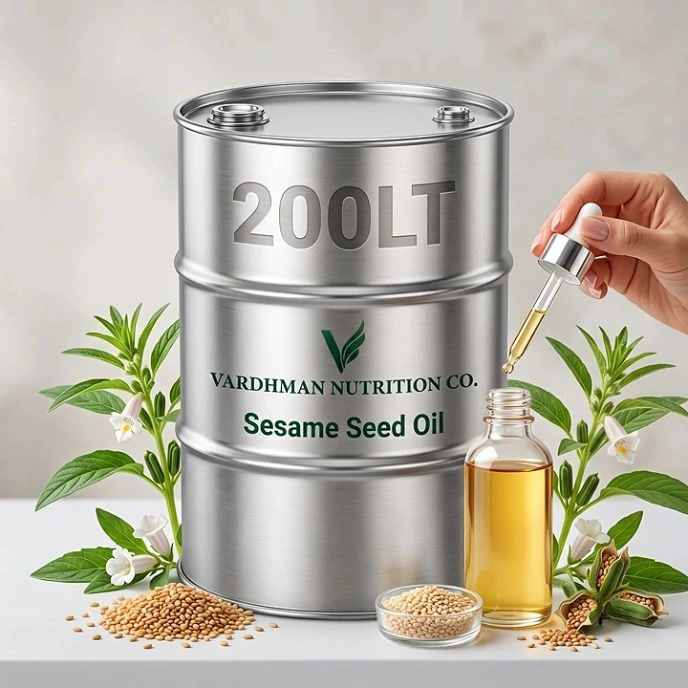
Vardhman Nutrition Co. is a Sesame Seed Oil Manufacturer, Bulk Supplier and Global B2B Exporter from India, supplying quality-focused Sesame Seed Oil for international businesses and commercial product manufacturers. Our Sesame Seed Oil is sourced and processed for applications across cosmetics, personal care, hair care, soap manufacturing, food and beverage, herbal formulations, nutraceutical products and other natural product categories.
Also known as Sesame Oil, Gingelly Oil, Til Oil and Sesamum Oil, Sesame Seed Oil is a versatile botanical oil obtained from the seeds of Sesamum indicum. Its broad formulation compatibility makes it a valuable raw material for brands, manufacturers, importers, distributors and private-label businesses seeking plant-based oil ingredients.
From Sesame Seeds to a Valuable Botanical Oil
Sesame seeds are the natural source of Sesame Seed Oil and have long been valued for their oil content and versatility. The oil obtained from these seeds can be incorporated into different commercial formulations depending on the required product specification and end use.
For international B2B procurement, consistency, documentation, packaging and dependable supply are important considerations. Vardhman Nutrition Co. focuses on supplying Sesame Seed Oil according to the requirements of global buyers looking for an India-based sourcing partner.
Sesamum indicum: Origin and Botanical Overview
Sesame Seed Oil is derived from Sesamum indicum, a cultivated oilseed plant belonging to the Pedaliaceae family. The seeds contain natural oil that can be mechanically processed to obtain Sesame Seed Oil.
The botanical identity of the raw material is an important consideration for manufacturers purchasing natural oils in bulk. Buyers can discuss their required specifications, intended application and documentation requirements with our export team before placing an order.
How Cold Pressed Sesame Seed Oil Is Produced
For natural oil applications, Cold Pressed Sesame Seed Oil is produced through mechanical pressing of selected sesame seeds. This method allows the oil to be obtained without relying on solvent extraction.
Cold pressing is particularly relevant for businesses developing natural, botanical and plant-based product ranges. The final characteristics of the oil can depend on the seed quality, processing conditions, filtration and storage practices.
For B2B orders, product specifications and processing details can be discussed according to the buyer's intended application and procurement requirements.
Natural Characteristics of Sesame Seed Oil
Sesame Seed Oil is valued by commercial formulators for its plant origin and versatility. Depending on the product specification and processing method, it may offer characteristics suitable for different formulation categories.
Common considerations for buyers include:
- Botanical source and product identity
- Extraction and processing method
- Appearance and physical characteristics
- Packaging requirements
- Batch consistency
- Documentation requirements
- Intended industrial application
- Bulk order quantity
These factors help international buyers select an oil that is appropriate for their manufacturing process.
Where Sesame Seed Oil Fits in Commercial Product Development
The versatility of Sesame Seed Oil allows it to be considered for a wide range of commercial product categories. Manufacturers may use it as a botanical oil ingredient in formulations where plant-based oils are required.
Its applications include:
- Cosmetics and personal care
- Skin and body care
- Hair and scalp care
- Natural soap manufacturing
- Food and beverage products
- Herbal and botanical formulations
- Nutraceutical product development
- Wellness and natural product lines
- Specialty oil formulations
The exact use depends on the buyer's formulation, applicable regulations and required product specifications.
Sesame Oil as an Ingredient for Beauty Formulations
The cosmetics and personal care sector is an important application area for botanical oils. Sesame Seed Oil for cosmetic formulations can be considered for products where a plant-derived oil is required as part of the formulation.
It can be incorporated into various product concepts such as:
- Body oils
- Massage oil blends
- Cosmetic oil formulations
- Moisturizing products
- Natural personal care products
- Botanical beauty formulations
- Oil-based cosmetic preparations
Manufacturers can select packaging and supply quantities according to their production requirements.
Creating Skin and Body Care Products with Sesame Oil
Sesame Seed Oil can be used in the development of different skin and body care formulations. Its botanical origin makes it relevant for brands creating natural and plant-based product ranges.
Potential commercial applications include body oils, massage blends, cleansing products and other oil-based personal care formulations.
For private-label and manufacturing companies, Sesame Seed Oil can also be combined with other botanical oils or natural ingredients to create customized product concepts.
Sesame Seed Oil for Hair Oil and Scalp Care Formulations
Hair care manufacturers can consider Sesame Seed Oil as a botanical ingredient for oil-based hair and scalp products. It can be used individually or blended with other suitable plant oils depending on the formulation objective.
Possible product categories include:
- Hair oils
- Scalp oil blends
- Botanical hair treatments
- Natural hair-care products
- Conditioning oil formulations
- Customized herbal oil blends
The final formulation should always be developed according to the manufacturer's technical requirements and applicable product regulations.
Its Role in Natural Soap and Cleansing Products
Soap manufacturers can incorporate plant-based oils into different cleansing formulations. Sesame Seed Oil for soap manufacturing can be considered for natural and botanical soap concepts.
It may be suitable for manufacturers producing:
- Botanical soaps
- Natural cleansing bars
- Plant-based soap products
- Specialty soaps
- Customized soap formulations
Bulk supply allows manufacturers to source the ingredient according to their production schedules and commercial requirements.
Sesame Seed Oil Applications in Food and Beverage Manufacturing
Sesame Seed Oil also has applications in the food and beverage sector. Depending on the specific grade, regulatory requirements and intended use, buyers may source Sesame Seed Oil for food-related manufacturing.
Food manufacturers should specify the intended application and required specifications before procurement so that the appropriate product documentation and supply requirements can be evaluated.
Use in Herbal, Nutraceutical and Botanical Formulations
Natural oils are also used across herbal, botanical and nutraceutical product development. Sesame Seed Oil may be incorporated into selected formulations where a plant-derived oil is required.
Potential commercial categories include:
- Herbal oil preparations
- Botanical formulations
- Nutraceutical product concepts
- Wellness products
- Traditional formulation categories
- Natural ingredient blends
The suitability of the oil depends on the formulation and regulatory requirements of the destination market.
Specialty and Wellness Product Development
Growing interest in natural ingredients has created opportunities for botanical oils across specialty product categories. Sesame Seed Oil can be considered by businesses developing natural wellness, personal care and botanical product ranges.
Its versatility allows manufacturers to explore different formulations while combining it with other natural oils and botanical ingredients where technically appropriate.
Bulk Sesame Seed Oil Supply for International Buyers
Vardhman Nutrition Co. provides bulk Sesame Seed Oil supply for international B2B buyers requiring commercial quantities from India.
Our potential customers include:
- Importers
- Wholesalers
- Distributors
- Cosmetic manufacturers
- Personal care companies
- Soap manufacturers
- Herbal product companies
- Nutraceutical brands
- Private-label businesses
- OEM manufacturers
- International trading companies
Bulk procurement can be planned according to product requirements, order quantity and shipment specifications.
Wholesale Procurement for Importers and Distributors
International wholesalers and distributors often require dependable sourcing, suitable packaging and documentation for their markets. Our wholesale Sesame Seed Oil supply from India is designed for businesses purchasing commercial quantities for further distribution or manufacturing.
Buyers can share their required quantity, destination country, packaging preference and application details to receive suitable commercial information.
Private Label Sesame Oil Supply for Global Brands
Brands looking to develop their own natural oil product range can explore private label Sesame Seed Oil supply. Private-label sourcing allows businesses to procure the required product for sale under their own brand, subject to applicable labeling and regulatory requirements.
Packaging, quantity and product specifications can be discussed based on the buyer's project requirements.
OEM Sourcing for Customized Sesame Oil Requirements
OEM sourcing is suitable for businesses with specific product, packaging or formulation requirements. Vardhman Nutrition Co. can discuss OEM Sesame Seed Oil requirements with buyers seeking customized B2B supply solutions.
Before production or shipment, buyers can communicate their specifications, packaging needs, quantity requirements and destination-market considerations.
Export Packaging Options for Bulk Orders
Packaging plays an important role in international shipment of natural oils. Sesame Seed Oil can be supplied in packaging formats selected according to order quantity, handling requirements and buyer preferences.
International buyers can discuss:
- Bulk packaging
- Commercial containers
- Customized packaging requirements
- Labeling requirements
- Shipment preparation
- Export documentation
The appropriate packaging solution can be finalized according to the order and destination.
Quality Information and Documents for B2B Procurement
For international procurement, buyers may require technical and commercial information before confirming an order. Depending on the product and order requirements, relevant documentation can be discussed with our export team.
Important procurement considerations may include:
- Product specifications
- Batch information
- Technical details
- Packaging information
- Commercial documentation
- Export documentation
- Destination-market requirements
This supports transparent communication between the supplier and international buyer.
Why Source Sesame Seed Oil from an Indian Manufacturer?
India is an established source of botanical ingredients and plant-based oils for international markets. Working directly with an Indian manufacturer and exporter can help B2B buyers streamline their sourcing process.
Vardhman Nutrition Co. focuses on:
- Manufacturer-level sourcing
- Bulk B2B supply
- Export-oriented procurement
- Consistent communication
- Flexible packaging discussions
- Product documentation support
- International shipment coordination
Our approach is focused on serving businesses rather than domestic retail customers.
Serving International Markets with Reliable Export Supply
Vardhman Nutrition Co. supplies natural botanical products to international B2B markets. Our export focus supports buyers across the USA, UK, Germany, European markets, UAE, Australia and South Korea.
We work with businesses seeking an India-based supplier for commercial quantities of Sesame Seed Oil and other natural ingredients.
A Practical Guide to Ordering Sesame Seed Oil in Bulk
Before requesting a quotation, international buyers can prepare the following information:
- Required Sesame Seed Oil quantity
- Intended application
- Preferred packaging
- Destination country
- Required documentation
- Shipping or delivery requirements
- Private-label or OEM requirements, if applicable
Providing these details helps our export team understand the requirement and prepare relevant commercial information.
Frequently Asked Questions About Sesame Seed Oil
What is Sesame Seed Oil?
Sesame Seed Oil is a botanical oil obtained from the seeds of Sesamum indicum. It is also commonly known as Sesame Oil, Gingelly Oil, Til Oil and Sesamum Oil.
Do you supply Sesame Seed Oil in bulk?
Yes. Vardhman Nutrition Co. supplies Sesame Seed Oil for international B2B buyers requiring commercial quantities.
Is Cold Pressed Sesame Seed Oil available?
Cold Pressed Sesame Seed Oil is among the product specifications that can be discussed for natural oil requirements. Buyers should mention their required processing specification when requesting a quotation.
Who can purchase Sesame Seed Oil from you?
Our B2B supply is suitable for importers, wholesalers, distributors, manufacturers, private-label brands, OEM companies and other commercial buyers.
Can I purchase Sesame Seed Oil for private label?
Yes. Private-label requirements can be discussed according to the buyer's product, packaging, labeling and market requirements.
Do you provide OEM Sesame Seed Oil supply?
Yes. OEM requirements can be discussed for customized commercial projects based on specifications, quantity and packaging requirements.
Which industries use Sesame Seed Oil?
Sesame Seed Oil can be considered for cosmetics, personal care, hair care, soap, food and beverage, herbal, botanical, nutraceutical and specialty natural product applications.
Do you export Sesame Seed Oil from India?
Yes. Vardhman Nutrition Co. operates as a Sesame Seed Oil Exporter from India, serving international B2B buyers and commercial procurement requirements.
Discuss Your Sesame Seed Oil Requirement with Our Export Team
If you are looking for a Sesame Seed Oil Manufacturer, Bulk Supplier or Exporter from India, Vardhman Nutrition Co. can discuss your commercial requirement.
Share your required quantity, application, packaging preference and destination country with our team. We can provide relevant product and commercial information for your bulk Sesame Seed Oil sourcing requirement.
Vardhman Nutrition Co. — Your India-based B2B sourcing partner for Sesame Seed Oil and natural botanical ingredients.




.webp)
.webp)
.webp)
.webp)