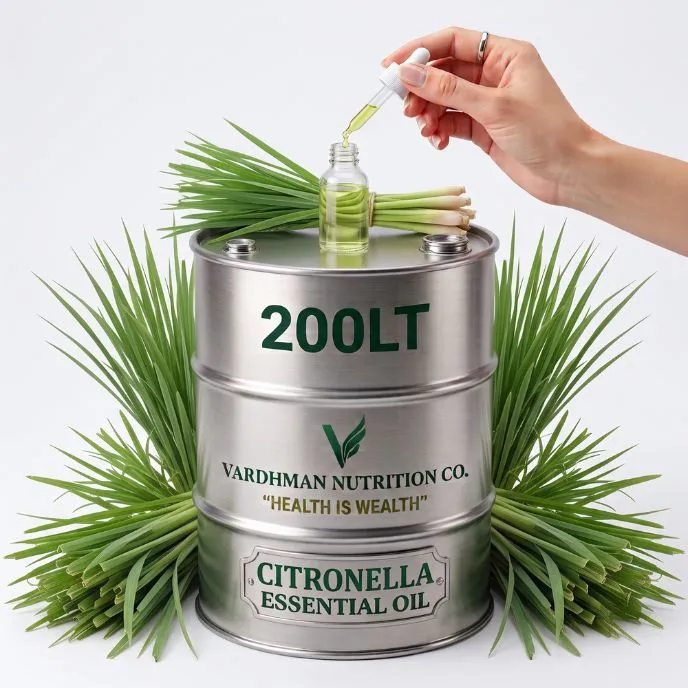
Citronella Essential Oil Manufacturer & Exporter in India – Bulk B2B Supply
Vardhman Nutrition Co. is a reliable Citronella Essential Oil Manufacturer in India and global Citronella Oil Exporter, supplying natural and steam-distilled Citronella Essential Oil to international B2B buyers, importers, wholesalers, distributors, manufacturers, formulators, and private-label businesses.
Citronella Essential Oil is obtained from aromatic grasses belonging to the Cymbopogon genus. It is especially recognized for its fresh, lemon-like, grassy, and slightly sweet fragrance. The oil is widely used in fragrance products, aromatherapy, personal care, cosmetics, soaps, household products, and insect-repellent formulations.
We provide Natural Citronella Essential Oil, Pure Citronella Oil, Bulk Citronella Oil, and Wholesale Citronella Essential Oil for businesses seeking dependable commercial sourcing from India.
1. What Is Citronella Essential Oil?
Citronella Essential Oil is a natural volatile oil extracted primarily from the leaves and tender stems of citronella grass. Two commercially recognized types are Cymbopogon nardus, commonly associated with Ceylon Citronella, and Cymbopogon winterianus, commonly known as Java Citronella.
The oil is particularly valued for its characteristic fresh, sharp, lemony, grassy, and mildly sweet aroma. Its distinctive fragrance makes it a popular ingredient for fragrance compositions, personal-care products, household products, and insect-repellent formulations.
Citronella grass is cultivated in several tropical and subtropical regions, including India and other parts of Asia and Africa.
2. Botanical Origin and Natural Characteristics
Citronella grass belongs to the Poaceae family and develops long, narrow, aromatic leaves containing volatile compounds.
The plant grows well in warm tropical and subtropical climates. India is an important source of aromatic grasses and botanical raw materials used in essential oil production.
The botanical origin, cultivation conditions, climate, soil, harvesting stage, and extraction process can influence the final aroma, composition, and quality of Citronella Essential Oil.
Its natural lemon-like fragrance is one of the main characteristics that makes Citronella Oil valuable to fragrance and personal-care manufacturers.
3. Fresh Lemon-Like Aroma for Fragrance Applications
Citronella Essential Oil is recognized for its fresh, sharp, lemon-like and grassy fragrance.
This aromatic profile makes it useful in fragrance blends where a fresh and clean character is desired. It can also be combined with other essential oils and fragrance ingredients to create customized aromatic compositions.
The oil is commonly incorporated into soaps, candles, air fresheners, personal-care products, household products, and fragrance formulations.
Its characteristic aroma also makes it a popular botanical ingredient for outdoor and insect-repellent product formulations.
4. Steam Distilled Citronella Essential Oil
Vardhman Nutrition Co. supplies Steam Distilled Citronella Essential Oil produced through steam distillation of suitable citronella grass material.
During steam distillation, prepared plant material is placed inside a distillation chamber. Steam passes through the botanical material and carries volatile aromatic compounds into a condenser.
The vapour is cooled and converted into liquid form. The essential oil is then separated from the water phase, filtered where required, and transferred into suitable containers.
The quality of the plant material, harvesting conditions, distillation parameters, and storage practices can influence the final characteristics of the oil.
5. How Citronella Oil Is Extracted
The production of Citronella Essential Oil generally follows several stages.
Harvesting: Citronella grass is harvested at a suitable stage of maturity.
Preliminary Drying: The harvested material may be partially dried to reduce excess moisture.
Preparation: Leaves and stems are prepared or cut into suitable sizes for efficient distillation.
Steam Distillation: Steam is passed through the plant material to release volatile aromatic components.
Condensation: The steam and essential oil vapour mixture is cooled in a condenser.
Separation: The condensed liquid is separated into essential oil and water phases.
Filtration: The extracted oil may be filtered to remove unwanted particles.
Packaging: The finished oil is stored in appropriate, tightly sealed containers to help preserve its quality.
6. Natural Chemical Constituents of Citronella Oil
Citronella Essential Oil contains naturally occurring aromatic compounds that contribute to its fragrance and functional characteristics.
Common constituents associated with Citronella Oil may include:
- Citronellal – An important component associated with the characteristic citronella aroma.
- Geraniol – Contributes floral and fresh fragrance notes.
- Citronellol – A naturally occurring aromatic alcohol used in fragrance compositions.
- Limonene – Contributes fresh citrus-like aromatic notes.
- Geranyl Acetate – Adds sweet and pleasant fragrance characteristics.
- Methyl Isoeugenol – Contributes warm aromatic notes.
- Myrcene – A naturally occurring terpene found in some citronella oils.
- Linalool – Contributes to the overall aromatic profile.
- Other naturally occurring terpenes and aromatic compounds.
The exact composition can vary according to species, geographical origin, cultivation conditions, harvesting practices, and extraction method. Batch-specific analysis can be used to determine the actual chemical profile.
7. Physical and Aromatic Properties of Citronella Oil
Citronella Essential Oil has several recognizable physical and aromatic characteristics.
- Color: Pale yellow to golden yellow
- Aroma: Fresh, sharp, lemon-like, grassy, and slightly sweet
- Nature: Light and fluid
- Volatility: Moderate to high
- Water Solubility: Insoluble in water
- Alcohol Solubility: Soluble in alcohol
- Carrier Oil Compatibility: Generally blends well with suitable vegetable oils
- Fragrance Profile: Fresh, citrus-like, green, and aromatic
The exact physical properties may vary depending on botanical source, extraction conditions, storage, and batch characteristics.
8. Citronella Oil for Insect-Repellent Products
Citronella is widely recognized for its use in natural insect-repellent formulations, particularly products designed to help repel mosquitoes and other insects.
Citronella Oil may be incorporated into:
- Mosquito-repellent products
- Outdoor fragrance products
- Insect-repellent candles
- Repellent sprays
- Aromatic diffusers
- Outdoor-use formulations
- Household insect-control products
For commercial products, the formulation, concentration, labeling, and regulatory requirements should be determined according to the destination market and intended application.
9. Applications in Cosmetics and Personal Care
Citronella Essential Oil is used in cosmetic and personal-care products where its fresh botanical fragrance is desired.
It can be incorporated into:
- Soaps
- Body washes
- Shampoos
- Conditioners
- Creams
- Lotions
- Massage oils
- Bath products
- Fragrance products
- Personal-care formulations
When used in topical formulations, the concentration and suitability should be evaluated according to the finished product requirements and applicable regulations.
10. Aromatherapy, Wellness and Household Uses
The refreshing aroma of Citronella Oil makes it suitable for a variety of aromatherapy and household applications.
It may be used in diffusers, aromatic blends, massage products, room fresheners, scented candles, linen products, and spa formulations.
In household products, its fresh fragrance is commonly incorporated into cleaning products, floor cleaners, detergents, air fresheners, and other scented formulations.
For aromatherapy and topical applications, appropriate dilution and product-specific usage guidelines should be followed.
11. Commercial Applications Across Industries
Our Commercial Citronella Essential Oil can be supplied for businesses operating in several industries, including:
- Fragrance and perfumery
- Cosmetics and personal care
- Aromatherapy and wellness
- Soap manufacturing
- Household cleaning products
- Scented candles
- Air fresheners
- Insect-repellent formulations
- Natural product manufacturing
- Herbal and botanical formulations
- Private-label products
- Other commercial applications
The suitability of Citronella Oil depends on the intended application, formulation, concentration, and destination-market requirements.
12. Bulk Citronella Essential Oil for B2B Buyers
Vardhman Nutrition Co. supplies Bulk Citronella Essential Oil for international businesses that require commercial quantities.
Our B2B supply is suitable for companies purchasing Citronella Oil for manufacturing, formulation, distribution, resale, or private-label production.
We understand that international buyers require more than product availability. Consistent quality, suitable packaging, technical information, clear communication, and shipment coordination are also important.
Our bulk supply can support:
- Importers
- Wholesalers
- Distributors
- Cosmetic manufacturers
- Fragrance companies
- Personal-care brands
- Aromatherapy businesses
- Private-label manufacturers
Bulk quantities and packaging requirements can be discussed according to individual buyer requirements.
13. Wholesale Citronella Essential Oil from India
Our Wholesale Citronella Essential Oil supply is designed for businesses purchasing commercial quantities for resale, distribution, manufacturing, or formulation.
International buyers can discuss requirements related to:
- Required quantity
- Packaging format
- Product specifications
- Samples
- Technical documentation
- Shipment requirements
- Export quotations
Our focus is on building dependable sourcing relationships with professional buyers who require regular or long-term supply from India.
14. Citronella Essential Oil Manufacturer in India
As a Citronella Essential Oil Manufacturer in India, Vardhman Nutrition Co. focuses on supplying natural botanical oils to international commercial customers.
Our export-oriented business approach is designed for buyers seeking reliable Indian sourcing for manufacturing, formulation, distribution, and private-label applications.
We work with customers to understand their commercial requirements and provide suitable supply solutions for bulk and wholesale procurement.
15. Citronella Oil Exporter Serving Global Markets
Vardhman Nutrition Co. is an international Citronella Oil Exporter from India, serving B2B customers across global markets.
Our international supply focus includes:
- USA
- UK
- Europe
- Germany
- UAE
- Australia
- South Korea
Export requirements can vary from one country to another. Product specifications, packaging, labeling, documentation, and shipment requirements can therefore be discussed according to the destination market.
Our objective is to provide professional and dependable sourcing support for international buyers.
16. Quality and Technical Documentation
For professional B2B buyers, technical documentation can be an important part of product evaluation and procurement.
Depending on product specifications, application, destination country, and customer requirements, documents may include:
- Certificate of Analysis (COA)
- GC-MS Report
- Safety Data Sheet (SDS/MSDS)
- Technical Data Sheet (TDS)
- Allergen Statement
- IFRA-related documentation, where applicable
The availability of specific documents depends on the product and individual customer requirements.
17. Storage and Handling of Citronella Oil
Proper storage can help preserve the natural aroma and quality of Citronella Essential Oil.
The oil should be stored in tightly sealed containers and protected from direct sunlight, excessive heat, moisture, and unnecessary exposure to air.
General storage practices include:
- Store in a cool and dry location.
- Protect from direct sunlight.
- Keep containers tightly sealed.
- Minimize repeated exposure to air.
- Use suitable dark-colored containers where appropriate.
- Keep away from excessive moisture.
- Store safely away from children and pets.
Because essential oils can undergo oxidation, suitable storage conditions are important for maintaining product quality.
18. Shelf Life and Product Stability
The shelf life of Citronella Essential Oil depends on factors such as oil quality, packaging, storage temperature, light exposure, oxygen exposure, and handling conditions.
When stored appropriately, Citronella Oil can maintain its characteristic aroma and quality for an extended period.
Signs such as significant color changes, an unusual sour or stale aroma, or noticeable changes in physical consistency may indicate oxidation or deterioration.
For commercial applications, buyers should follow the shelf-life and storage information provided with the relevant product documentation.
19. Why Choose Vardhman Nutrition Co.?
Vardhman Nutrition Co. focuses on reliable B2B Citronella Essential Oil supply from India for international businesses.
Our key advantages include:
- Citronella Essential Oil Manufacturer in India
- Experienced Citronella Oil Exporter
- Natural and steam-distilled Citronella Oil
- Bulk and wholesale supply
- Export-oriented B2B business approach
- Supply for importers, wholesalers, and distributors
- Commercial quantities for manufacturers
- Packaging and shipment coordination
- Technical documentation support
- Focus on consistent commercial quality
- International sourcing assistance
- Long-term B2B business relationships
20. Buy Citronella Essential Oil in Bulk from India
If you are looking to Buy Citronella Essential Oil in Bulk from India, Vardhman Nutrition Co. can support your commercial sourcing requirements.
We supply Natural Citronella Essential Oil, Pure Citronella Oil, Steam Distilled Citronella Oil, Bulk Citronella Essential Oil, and Wholesale Citronella Essential Oil for international businesses involved in cosmetics, personal care, perfumery, aromatherapy, household products, fragrance manufacturing, and insect-repellent formulations.
Whether you are an importer, wholesaler, distributor, manufacturer, fragrance company, cosmetic business, aromatherapy brand, or private-label company, we can discuss your required quantity, product specifications, packaging, documentation, samples, and export requirements.
Looking for a dependable Citronella Essential Oil B2B Supplier in India?
Contact Vardhman Nutrition Co. for bulk and wholesale Citronella Essential Oil requirements, samples, technical documentation, packaging options, and export quotations.
We aim to build reliable, transparent, and long-term B2B partnerships with international buyers seeking quality Citronella Essential Oil from India.








.webp)
.webp)
.webp)
.webp)