Cardamom Essential Oil Manufacturer, Bulk Supplier & Exporter from India
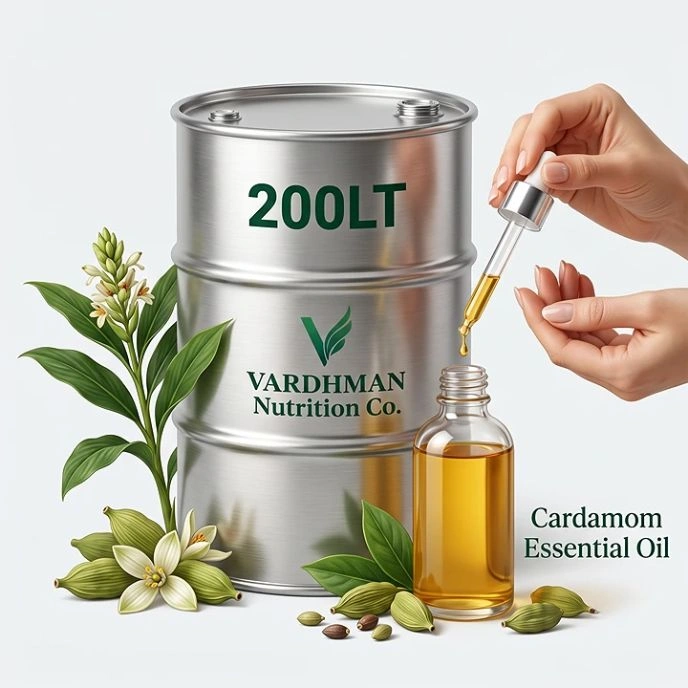
Vardhman Nutrition Co. is a Cardamom Essential Oil Manufacturer, Bulk Supplier and Exporter from India, supplying Natural Cardamom Essential Oil for international B2B requirements. Our Cardamom Oil is suitable for importers, wholesalers, distributors, manufacturers, formulation companies and private label businesses looking for dependable botanical ingredient sourcing.
Cardamom Essential Oil is obtained from the seeds of Elettaria cardamomum, commonly known as Green Cardamom or True Cardamom. It is recognized for its distinctive sweet, spicy, fresh, warm and mildly balsamic aromatic profile. This versatile botanical oil is used across fragrance, food-related, cosmetic, personal care, aromatherapy and herbal product applications.
As an export-focused Cardamom Oil Supplier from India, Vardhman Nutrition Co. supports bulk sourcing requirements for international markets including the USA, UK, Europe, Germany, UAE, Australia, South Korea and other global destinations.
What Is Cardamom Essential Oil?
Cardamom Essential Oil is a concentrated volatile oil derived from cardamom seeds. Green Cardamom has been valued for generations as an aromatic spice, and its essential oil captures the characteristic fragrance of the botanical material in a concentrated form.
The oil generally appears as a pale yellow to nearly colorless liquid. Its sweet-spicy, fresh and warm aroma makes it a useful botanical ingredient for fragrance compositions, personal care products, aromatherapy blends, wellness formulations and food-related applications where permitted.
Cardamom Essential Oil Botanical Information
| Botanical Name | Elettaria cardamomum |
|---|---|
| Common Name | Green Cardamom / True Cardamom |
| Botanical Family | Zingiberaceae |
| Part Used | Seeds |
| Product Type | Essential Oil |
| Appearance | Pale yellow to almost colorless liquid |
| Aroma | Sweet, spicy, fresh, warm and mildly balsamic |
| Common Extraction Method | Steam Distillation |
Distinctive Aroma of Cardamom Oil
The fragrance of Cardamom Essential Oil is one of its most valuable commercial characteristics. It combines a sweet and spicy opening with a fresh, warm and slightly balsamic character.
This aromatic profile allows Cardamom Oil to be incorporated into different fragrance systems and botanical formulations. It can also be blended with other essential oils and aromatic ingredients to create customized fragrance profiles for commercial products.
Natural Constituents of Cardamom Essential Oil
Cardamom Essential Oil contains naturally occurring volatile compounds responsible for its characteristic aroma and functional properties. Important constituents may include:
- 1,8-Cineole (Eucalyptol)
- Alpha-Terpinyl Acetate
- Linalool
- Limonene
- Sabinene
- Myrcene
- Alpha-Pinene
- Beta-Pinene
- Terpinen-4-ol
- Alpha-Terpineol
- Nerol
- Geraniol
- Citronellol
- Linalyl Acetate
- p-Cymene
- Methyl Eugenol
- Trans-Nerolidol
1,8-Cineole and Alpha-Terpinyl Acetate are important components associated with the fresh and spicy aromatic character of Cardamom Oil. The actual composition can vary depending on botanical source, processing conditions and batch characteristics.
Cardamom Essential Oil Extraction Process
Cardamom Essential Oil is commonly obtained through steam distillation. This method separates volatile aromatic components from prepared cardamom seeds.
1. Selection of Cardamom Seeds
Suitable cardamom botanical material is selected according to the required processing specifications and quality considerations.
2. Cleaning and Seed Preparation
Cardamom seeds are separated and cleaned to remove unwanted foreign material before the extraction process.
3. Controlled Drying and Preparation
The prepared seeds may undergo suitable drying and preparation to facilitate the release of volatile aromatic components.
4. Steam Distillation
Prepared cardamom seeds are loaded into a distillation chamber. Steam passes through the botanical material and carries the volatile oil components with it.
5. Condensation
The oil-containing vapour is cooled in a condenser, producing a liquid mixture of water and essential oil.
6. Oil Separation
The essential oil is separated from the condensed water using suitable separation equipment.
7. Filtration and Storage
The collected oil may be filtered as required and transferred into suitable containers that help protect its aromatic characteristics during storage and transportation.
Commercial Applications of Cardamom Essential Oil
The versatile aromatic character of Cardamom Essential Oil makes it suitable for numerous commercial applications across different industries.
Food & Flavour Applications
Cardamom has a strong association with food and beverage formulations. Cardamom Essential Oil may be considered for flavour and aroma applications where permitted by applicable regulations.
- Flavoured beverages
- Herbal drinks
- Bakery products
- Confectionery
- Spice-based formulations
- Food flavouring systems
- Herbal tea products
Cosmetics & Personal Care
Cardamom Oil can add a distinctive warm and spicy aromatic character to cosmetic and personal care formulations.
- Skin care formulations
- Body oils
- Creams and lotions
- Soaps
- Cleansers
- Massage products
- Botanical personal care products
Perfume & Fragrance Manufacturing
The sweet and spicy aroma of Cardamom Essential Oil makes it valuable for fragrance development. It may be used in fine fragrance compositions, natural perfume blends, fragrance concentrates and other aromatic products.
Aromatherapy & Wellness
Cardamom Essential Oil is also popular in aromatherapy and wellness formulations because of its fresh and invigorating fragrance. It may be incorporated into diffuser blends, massage oils, spa products and other aromatic applications.
Herbal & Botanical Products
Cardamom has a long history of use in traditional herbal systems. Its essential oil may be considered as a botanical ingredient in traditional-inspired and wellness-oriented formulations.
Why Manufacturers Choose Cardamom Essential Oil
Cardamom Essential Oil offers a combination of distinctive aroma, botanical origin and formulation versatility that makes it attractive to manufacturers and product developers.
- Distinctive sweet and spicy aromatic profile
- Fresh and warm fragrance character
- Suitable for fragrance formulations
- Useful in personal care development
- Popular in aromatherapy products
- Suitable for botanical formulations
- Used in food-related applications where permitted
- Suitable for bulk commercial sourcing
- Can be blended with other aromatic ingredients
- Suitable for international B2B requirements
Bulk Cardamom Essential Oil Supplier from India
Vardhman Nutrition Co. supplies Bulk Cardamom Essential Oil for international B2B requirements. Our supply approach is intended for businesses that require commercial quantities for manufacturing, formulation, distribution or private label production.
We work with:
- Essential oil importers
- International wholesalers
- Distributors and traders
- Cosmetic manufacturers
- Personal care companies
- Perfume and fragrance manufacturers
- Food ingredient businesses
- Herbal product manufacturers
- Aromatherapy businesses
- Private label companies
- Contract manufacturers
Cardamom Essential Oil Manufacturer in India
Vardhman Nutrition Co. operates as an India-based Cardamom Essential Oil Manufacturer with an export-focused B2B supply model. We support overseas businesses sourcing botanical oils from India for manufacturing, formulation, wholesale distribution and private label requirements.
Commercial buyers can discuss product specifications, quantity, packaging, technical documentation and destination-market requirements according to their individual sourcing needs.
Cardamom Essential Oil Exporter from India
Vardhman Nutrition Co. supports international buyers searching for a dependable Cardamom Essential Oil Exporter from India. Our export-oriented supply model is suitable for businesses sourcing Natural Cardamom Oil for commercial applications.
We support B2B sourcing requirements for markets including:
- United States (USA)
- United Kingdom (UK)
- Germany
- European markets
- United Arab Emirates (UAE)
- Australia
- South Korea
- Other international destinations
Wholesale Cardamom Oil for International Buyers
International buyers sourcing Wholesale Cardamom Oil generally require more than the product itself. Consistent quality, appropriate packaging, technical information and dependable shipment coordination can also be important for commercial procurement.
Buyers looking to buy Cardamom Essential Oil in bulk from India can provide their required quantity, application, packaging preference and destination country for commercial discussion and quotation.
Export Packaging for Bulk Cardamom Oil
Appropriate packaging helps protect essential oil quality during storage, handling and international transportation.
Depending on quantity and buyer requirements, packaging may include:
- Aluminium bottles
- Aluminium containers
- Export-grade drums
- Bulk industrial packaging
- Customized commercial packaging
Quality Control & Technical Documentation
Technical documentation can be an important part of international B2B essential oil sourcing. Depending on the product, batch and intended application, applicable documents may include:
- Certificate of Analysis (COA)
- GC-MS Report
- Safety Data Sheet (SDS/MSDS)
- Technical Data Sheet (TDS)
- Allergen Statement
- IFRA-related documentation where applicable
- Other applicable product or export documentation
Documentation availability may depend on the specific product, batch, intended application and buyer requirements.
Storage Guidelines for Cardamom Essential Oil
Proper storage is important for maintaining the characteristic aroma and overall quality of Cardamom Essential Oil.
- Store in a cool and dry environment.
- Protect the oil from direct sunlight.
- Keep containers tightly closed.
- Minimize unnecessary exposure to air.
- Protect from excessive heat and humidity.
- Use suitable light-protective containers.
- Avoid unsuitable packaging materials for prolonged storage.
- Keep away from children and pets.
Shelf Life of Cardamom Essential Oil
Cardamom Essential Oil can remain suitable for commercial use for an extended period when stored under recommended conditions. A typical shelf-life range may be around 24–36 months, subject to product specifications and storage conditions.
Exposure to heat, light, oxygen and humidity can influence essential oil stability over time. Buyers should refer to product-specific technical documentation for recommended storage and shelf-life details.
Safety and Responsible Use
Cardamom Essential Oil is a concentrated aromatic material and should be handled appropriately. Natural origin does not automatically mean that an essential oil is suitable for direct ingestion or undiluted topical application.
Commercial manufacturers should evaluate the intended application, appropriate concentration, product compatibility, safety documentation and applicable regulations of the destination market before formulation.
Why Choose Vardhman Nutrition Co.?
Vardhman Nutrition Co. focuses on supplying essential oils and botanical ingredients to international B2B customers. Our approach is designed around the commercial requirements of importers, wholesalers, distributors and manufacturers.
- India-based essential oil manufacturing and sourcing
- Export-focused B2B supply
- Bulk and wholesale quantities
- Natural botanical oil sourcing
- International buyer support
- Suitable export packaging options
- Technical documentation support
- Commercial quotation assistance
- Support for importers and distributors
- Supply for cosmetic and personal care manufacturers
- Fragrance and perfume industry support
- Aromatherapy and wellness applications
- Private label and commercial sourcing discussions
Frequently Asked Questions About Cardamom Essential Oil
What is Cardamom Essential Oil?
Cardamom Essential Oil is a volatile aromatic oil obtained from the seeds of Elettaria cardamomum. It is recognized for its sweet, spicy, fresh and warm fragrance.
Is Cardamom Essential Oil available in bulk?
Yes. Cardamom Essential Oil can be sourced in bulk and wholesale quantities for international B2B manufacturing, formulation and distribution requirements.
Who buys Cardamom Essential Oil?
Importers, wholesalers, distributors, cosmetic manufacturers, personal care companies, fragrance manufacturers, food ingredient businesses, herbal product companies and private label businesses may source Cardamom Oil.
What is the botanical name of Cardamom?
The botanical name of Green or True Cardamom is Elettaria cardamomum.
How is Cardamom Essential Oil extracted?
Cardamom Essential Oil is commonly obtained through steam distillation of prepared cardamom seeds.
Can Cardamom Oil be used in perfumes?
Yes. Its warm, sweet and spicy aromatic profile makes it suitable for various perfume and fragrance compositions.
Buy Cardamom Essential Oil in Bulk from India
If you are looking for a reliable Cardamom Essential Oil Manufacturer, Bulk Supplier and Exporter from India, Vardhman Nutrition Co. can support your international B2B sourcing requirements.
Share your required quantity, destination country, intended application and packaging requirements to discuss product specifications, documentation, samples and export quotation.
Vardhman Nutrition Co. – Your B2B sourcing partner for Bulk Cardamom Essential Oil from India.
.webp)
.webp)
.webp)
.webp)