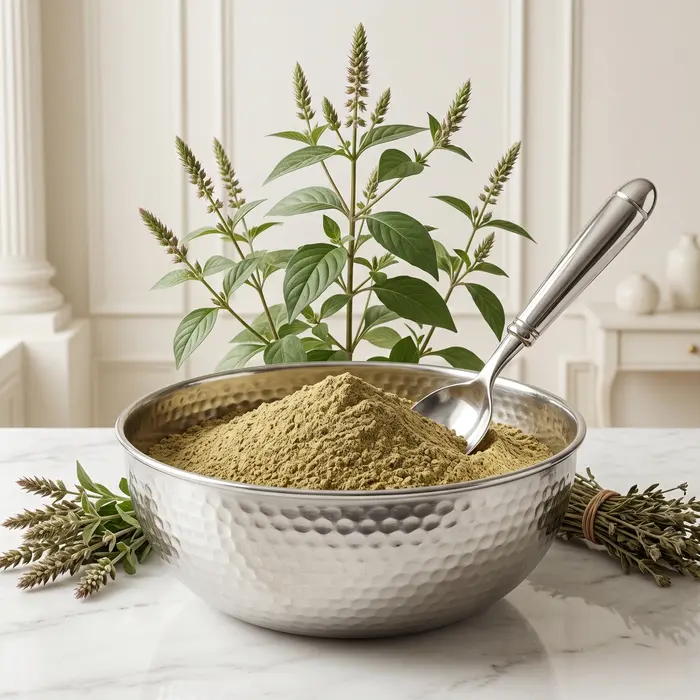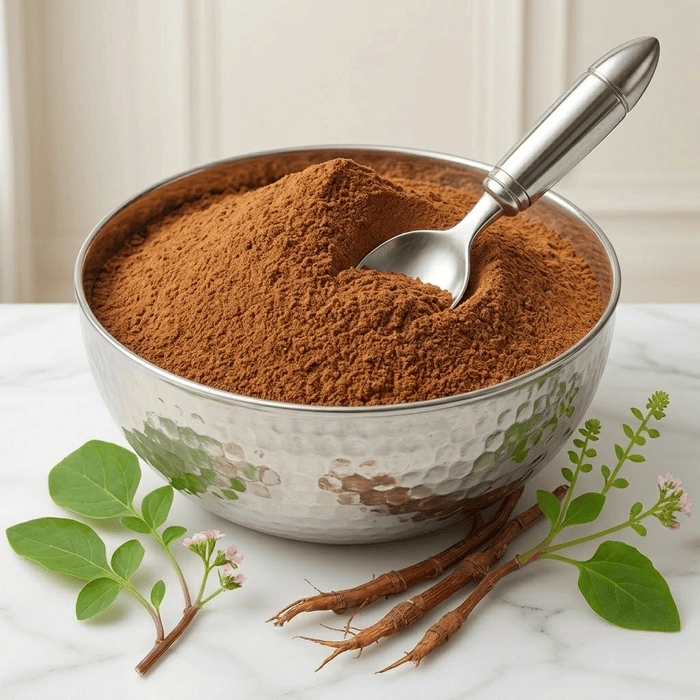
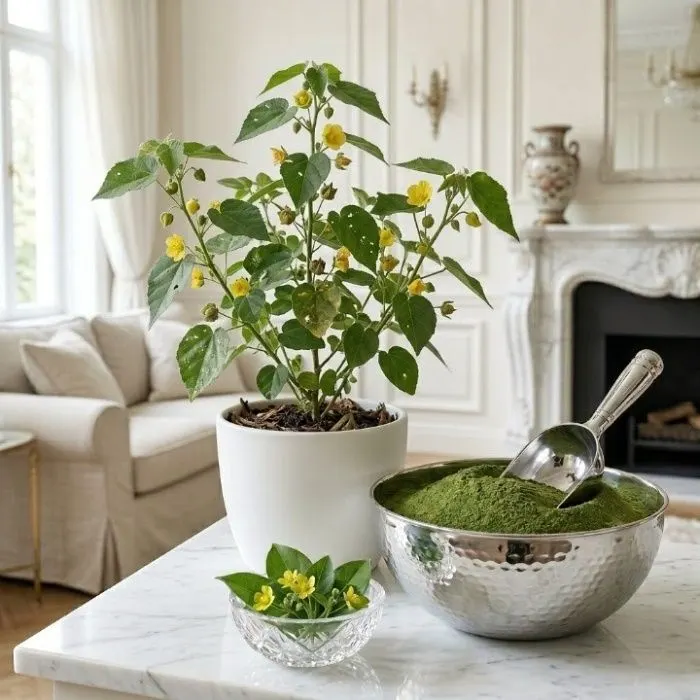
Product Name: Atibala Leaf powder
Botanical Name : Abutilon indicum
Form : Dried Raw Herb - Powder
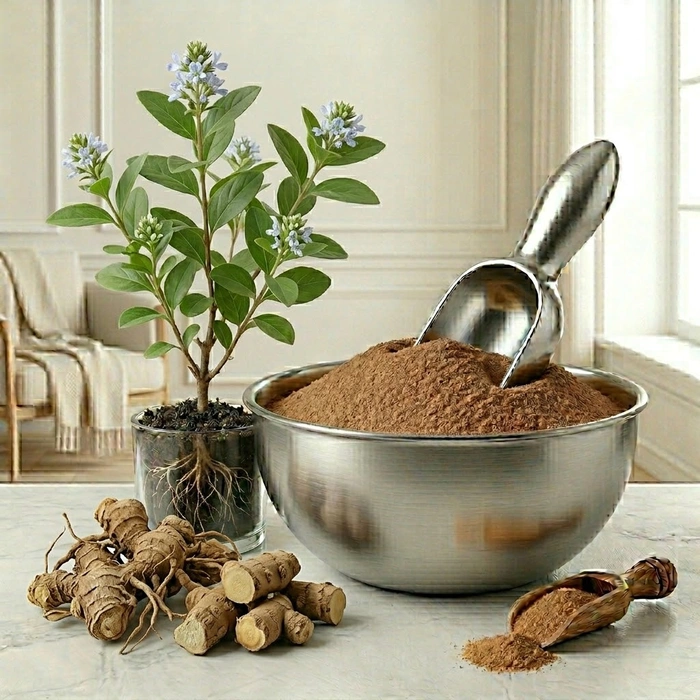
Vardhman Nutrition Co. is an India-based manufacturer, supplier and global B2B exporter of botanical herbs, providing India-origin Atibala Leaf Powder for international businesses involved in herbal manufacturing, Ayurvedic formulations, nutraceutical development, cosmetic production and botanical ingredient distribution. The ingredient is prepared from carefully selected leaves of Abutilon indicum, a traditional Indian botanical associated with Ayurveda and several herbal systems.
Atibala is commonly identified by names such as Atibala, Kanghi and Indian Mallow. It belongs to the Malvaceae family and is traditionally recognized in Indian herbal practices. The plant is a perennial shrub with soft, velvety, heart-shaped leaves. Selected leaves are cleaned, dried under controlled conditions and processed into a fine powdered botanical ingredient suitable for commercial formulation requirements.
Vardhman Nutrition Co. focuses on international B2B supply from India rather than domestic retail distribution. Overseas importers, wholesalers, distributors, herbal manufacturers, Ayurvedic companies, nutraceutical businesses, pharmaceutical organizations, cosmetic manufacturers and private-label brands can discuss commercial requirements according to quantity, grade, mesh, packaging, technical specifications and destination-market needs.
The company provides an India-origin sourcing option for businesses that require botanical raw materials for further manufacturing, formulation or distribution.
Atibala has traditionally been associated with Indian herbal knowledge and is found across various tropical regions. The plant is recognized for its characteristic soft leaves and natural botanical profile. For commercial powder production, appropriate leaves are selected and processed to obtain a dried material that can be conveniently handled, packed and transported.
The finished powder can naturally differ in colour, aroma, texture and taste. Such variations may be influenced by geographical origin, plant maturity, cultivation conditions, harvesting period, drying method, processing procedure and storage environment.
For an international buyer, botanical identity is an important part of procurement. The material is identified as Abutilon indicum, with leaves being the specified plant part. Buyers can communicate their required grade, particle size, mesh and technical parameters before commercial supply.
This approach allows manufacturers to align the botanical raw material with their own formulation and quality-control requirements.
The supplied botanical information identifies the plant as Abutilon indicum, belonging to the Malvaceae family, with leaves used as the specified plant part and India listed as the origin.
Global procurement teams may search for the same botanical ingredient using common names, scientific terminology or descriptions based on the plant part. Relevant commercial search phrases include Atibala Powder, Atibala Leaves Powder, Abutilon indicum Powder, Abutilon indicum Leaf Powder, Indian Mallow Powder, Indian Mallow Leaf Powder, Dried Atibala Leaf Powder, Atibala Herbal Powder, Atibala Leaves, Kanghi Powder, Kanghi Leaf Powder and Abutilon indicum Herb.
Using botanical nomenclature together with the common name can help international purchasing departments communicate the intended material more accurately. This becomes particularly useful when importers compare suppliers from different regions or when manufacturers maintain detailed raw-material specifications.
For commercial sourcing, the buyer should confirm the botanical name, plant part, grade and technical specification before finalizing the order.
Atibala has a traditional association with Ayurveda and Indian herbal practices. Different parts of the plant have been incorporated into traditional preparations according to the formulation and intended use.
Manufacturers developing suitable traditional products may consider Atibala Leaf Powder for Ayurvedic Products as an India-origin botanical raw material. Potential formulation formats include Ayurvedic powder blends, herbal preparations, botanical combinations, traditional formulations, capsules, tablets, wellness products and multi-herb preparations.
Traditional Ayurvedic descriptions associate Atibala with strengthening and cooling characteristics and with traditional Vata-Pitta balancing concepts.
For international manufacturers, the intended finished-product category is important. The appropriate botanical grade, formulation quantity, processing method and labeling approach should be determined according to the finished product and destination-market regulations.
Traditional use does not establish a guaranteed therapeutic result. Any finished product carrying health-related claims should be appropriately formulated, evaluated, tested and labeled according to applicable legal requirements.
Leaf-based botanical ingredients can be incorporated into various herbal formulations depending on the manufacturer's formulation strategy. Atibala Herbal Powder may be evaluated as a plant-based ingredient for suitable traditional and botanical preparations.
Potential commercial formats include traditional herbal blends, botanical powder combinations, Ayurvedic preparations, herbal wellness products, multi-botanical formulations and powder-based herbal products.
Manufacturers may require different particle sizes depending on their production process. For example, a formulation manufacturer may require a particular mesh for blending, encapsulation or further processing.
The supplier and buyer can discuss these requirements before commercial procurement so that the requested specification is clearly understood.
Botanical ingredients are widely considered by companies developing plant-based wellness and nutraceutical products. Atibala Leaf Powder for Nutraceutical Industry can be evaluated as a botanical raw material for appropriate formulations where the ingredient is permitted for the intended application.
Potential product formats include herbal powder blends, botanical formulations, nutraceutical products, capsules, botanical tablets, wellness blends and multi-herb combinations.
International nutraceutical companies may require detailed technical information before approving a new raw material. Parameters such as botanical identity, plant part, appearance, particle size, moisture, microbiological quality and packaging may form part of the procurement specification.
Finished nutraceutical products should be assessed according to the regulations applicable in the country where the product will be marketed.
The leaf material has a broad traditional presence within Indian herbal knowledge. Its traditional applications include preparations associated with respiratory wellness, digestive support, urinary wellness, skin care, wound-related applications and general physical strength.
For commercial formulation, manufacturers may evaluate the botanical according to their own product concept and technical requirements.
Potential areas include:
The final use of the ingredient depends on formulation compatibility, permitted application, product specification and destination-market requirements.
Atibala leaves may also be considered by companies developing plant-based beauty and personal-care products. Atibala Leaf Powder for Cosmetic Industry can be evaluated for suitable botanical formulations according to the intended product concept.
Potential applications include herbal face packs, botanical masks, plant-based cleansing products, herbal personal-care formulations, botanical skin-care concepts, traditional beauty preparations and powder-based cosmetic products.
The naturally occurring mucilage associated with the leaves may be relevant to formulation concepts focused on soothing or moisturizing botanical characteristics.
However, finished-product performance depends on the complete formulation. Cosmetic manufacturers should assess ingredient compatibility, microbial quality, stability, safety and regulatory suitability before commercialization.
The leaves of Abutilon indicum contain naturally occurring plant compounds that contribute to the botanical profile of the material. The supplied source describes several classes of phytochemicals reported in botanical and phytochemical literature.
These include flavonoids, alkaloids, phenolic compounds, tannins, glycosides, saponins and other naturally occurring constituents.
Reported compounds include:
The botanical material is also described as containing minerals such as calcium, potassium, magnesium, iron and zinc, together with vitamins including Vitamin C and Vitamin E.
The concentration of naturally occurring constituents can vary between batches because of geographical origin, plant maturity, cultivation conditions, harvesting period, drying method, processing procedure and storage conditions.
Where a particular botanical marker or quantitative value is required, buyers should rely on batch-specific laboratory analysis rather than assuming identical values across all lots.
Traditional herbal literature associates Atibala with several properties. The supplied content describes strengthening, anti-inflammatory, analgesic, antipyretic, anti-cough, respiratory-supportive, diuretic, wound-supportive, blood-purifying, anti-parasitic, antibacterial, antioxidant, hepatoprotective and immunomodulatory properties.
The leaves have traditionally been used in preparations associated with respiratory wellness, throat comfort, digestive support, urinary wellness, skin care and general physical strength.
From an Ayurvedic perspective, the supplied material describes the herb as having sweet, bitter and astringent taste characteristics, light and dry qualities, cooling potency and pungent post-digestive effect.
These properties represent traditional herbal descriptions and should not be converted into guaranteed disease-treatment claims for commercial products.
Scientific investigations have explored different properties of Abutilon indicum and its extracts. Research described in the supplied material includes antioxidant, anti-inflammatory, analgesic, antibacterial, antifungal, wound-healing, blood-sugar-related, liver-protective and diuretic areas.
Flavonoids and phenolic compounds have been investigated for antioxidant activity and free-radical-scavenging potential. Laboratory and animal studies have also examined anti-inflammatory and pain-relieving effects.
Experimental research has investigated antibacterial and antifungal activity against selected organisms. Wound-healing potential has also been evaluated in experimental models.
Preliminary animal research has explored possible hypoglycemic activity, while other studies have investigated potential protective effects against toxin-induced liver damage. Experimental research has additionally examined diuretic activity.
The supplied source emphasizes that many existing findings are based on laboratory and animal studies, meaning further human research would be required to establish definitive therapeutic applications.
For international manufacturers, scientific literature may provide background information, while finished-product claims should be based on appropriate evidence and regulatory evaluation.
Controlled processing is important for preparing a consistent dried botanical ingredient for commercial procurement. A typical production sequence begins with the selection of suitable leaves.
The processing route may include:
Processing requirements can change according to the intended commercial grade, application, particle size and buyer specification.
For international orders, manufacturers can communicate their preferred mesh and technical requirements before supply is finalized.
Professional buyers generally require a defined specification before approving a botanical ingredient. Depending on the intended application, the technical profile may include botanical identity, plant part, appearance, natural colour, characteristic aroma, taste, particle size, mesh specification and moisture.
Additional parameters may include foreign matter, microbiological characteristics, heavy metals where applicable, pesticide residues where applicable and botanical markers where specified.
The acceptance limits should be agreed according to the buyer's product specification and the requirements applicable to the destination market.
Batch-specific testing becomes especially relevant when an importer or manufacturer requires a particular quantitative or quality parameter for internal approval.
Vardhman Nutrition Co. provides Bulk Atibala Leaf Powder for professional buyers requiring commercial quantities from India.
The potential customer base includes Ayurvedic manufacturers, herbal product companies, nutraceutical manufacturers, pharmaceutical businesses, cosmetic manufacturers, personal-care brands, botanical distributors, importers, wholesalers and private-label companies.
Commercial procurement can be discussed according to quantity, mesh, packaging, product grade, intended application and documentation requirements.
This supply model is intended for businesses that use botanical raw materials for manufacturing, formulation, distribution or international trade.
As an Atibala Leaf Powder Wholesale Supplier, Vardhman Nutrition Co. supports businesses purchasing botanical ingredients for manufacturing and international distribution.
Wholesale procurement may involve regular purchasing programs, commercial quantities, customized particle size, export packaging, technical documentation, buyer-specific specifications and contract supply.
International buyers can communicate their requirements before shipment so that product specifications and commercial details are clearly aligned.
Vardhman Nutrition Co. operates as an Atibala Leaf Powder B2B Supplier, supporting professional organizations involved in international botanical sourcing.
Businesses searching for an Atibala Leaf Powder B2B Manufacturer or Atibala Leaf Powder B2B Exporter can discuss bulk orders, product specifications, packaging, private-label projects, contract supply, export documentation and destination-country requirements.
The company's supply approach is focused on international B2B procurement and India-origin botanical sourcing.
For overseas organizations researching an Atibala Leaf Powder Manufacturer in India, Vardhman Nutrition Co. provides an India-origin sourcing option for commercial botanical requirements.
Other relevant international procurement terms include Atibala Powder Manufacturer, Atibala Leaves Powder Supplier, Atibala Herbal Powder Supplier, Abutilon indicum Powder Supplier from India, Abutilon indicum Leaf Powder Manufacturer, Indian Mallow Powder Supplier, Indian Mallow Leaf Powder Exporter, Kanghi Powder Supplier and Bulk Atibala Leaf Powder Supplier.
These terms reflect the different ways international purchasing teams may search for an India-based botanical ingredient source.
Vardhman Nutrition Co. is an Atibala Leaf Powder Exporter from India, supporting international B2B buyers seeking India-origin botanical raw materials.
Commercial export enquiries can cover required quantity, product grade, particle size, intended application, packaging format, technical specifications, destination country and documentation.
The export process can be discussed according to the buyer's specific requirements and the applicable conditions of the destination market.
For overseas procurement, clear communication of product specifications is important before shipment.
Vardhman Nutrition Co. supports commercial enquiries related to Atibala Leaf Powder Export to USA from India.
Potential US buyers include herbal manufacturers, nutraceutical businesses, botanical distributors, private-label companies and importers seeking India-origin raw materials.
Buyers can communicate their required quantity, product specification, packaging preference, intended application and documentation needs for commercial evaluation.
Destination-specific requirements should be reviewed according to the intended use, imported botanical material and finished product category.
International companies can enquire about Atibala Leaf Powder Export from India to UK, Europe and Germany for suitable herbal, botanical, nutraceutical, cosmetic and personal-care applications.
Purchasing teams in these markets may require botanical identification, technical specifications, quality parameters, packaging information and relevant documentation before approving a supplier.
The required specification can be discussed according to the buyer's manufacturing process and destination-market requirements.
Vardhman Nutrition Co. also supports international B2B enquiries from markets including UAE, Australia and South Korea.
Importers and manufacturers in these regions can provide their destination country, required quantity, intended application, product specification, packaging preference and technical documentation requirements.
The applicable import and product regulations should be reviewed according to the destination and intended finished-product category.
International brands developing their own herbal and plant-based product ranges may require customized procurement arrangements. Relevant commercial requirements include Atibala Leaf Powder Private Label, Atibala Private Label Supplier and Atibala Leaf Powder Private Label Manufacturer.
Depending on the project, commercial discussions may include customized packaging, OEM botanical ingredient supply, contract supply and buyer-specific labeling.
Private-label requirements should be finalized according to the finished product, packaging format and destination-market regulations.
This model can be useful for businesses seeking an India-origin botanical ingredient while developing products under their own brand identity.
Suitable packaging is important for protecting dried botanical powder during storage, handling and international transportation.
Depending on the product, order and destination, documentation may include:
The exact document package should be confirmed according to the buyer's requirements and destination-market conditions.
Proper storage is important for maintaining the characteristics of dried leaf powder.
General storage recommendations include keeping the material in a clean and dry environment, protecting it from excessive humidity, using suitable airtight packaging, avoiding direct sunlight and excessive heat, keeping it away from strong-smelling substances and preventing contamination during handling.
After opening, packaging should be properly resealed. Clean and dry handling equipment should be used.
For bulk quantities, buyers should maintain appropriate warehouse temperature and humidity conditions and follow the relevant product specification or batch documentation.
The stability of a dried botanical ingredient depends on several factors. These include raw-material quality, leaf maturity, drying conditions, moisture level, processing method, packaging material, storage environment and microbiological quality.
The actual shelf-life period should be established through the applicable batch specification rather than assuming one fixed duration for every commercial grade.
Possible signs of deterioration can include excessive darkening or browning, unpleasant or stale odour, moisture-related lump formation, dampness, visible mould growth, insect infestation or unusual changes in taste and natural aroma.
Appropriate packaging and controlled storage conditions can help protect the material throughout its intended storage period.
Vardhman Nutrition Co. is an India-based manufacturer and global B2B exporter specializing in Botanical Herbs. The company supplies India-origin natural ingredients to importers, distributors, herbal manufacturers, nutraceutical brands, cosmetic businesses and pharmaceutical organizations worldwide.
The company identifies itself as an ISO 9001:2015 certified organization and states that its quality system covers stages from raw-material inspection through final packaging.
For international buyers, this India-based sourcing model provides a commercial channel for procuring botanical raw materials according to defined specifications.
The buyer can communicate the required botanical identity, plant part, grade, quantity, mesh, packaging, application, destination and documentation needs during the enquiry process.
To make procurement discussions more efficient, international buyers can provide:
Providing these details at the beginning helps establish a clearer commercial specification and allows the supplier to understand the buyer's procurement requirements.
It is a dried and ground botanical ingredient prepared from the leaves of Abutilon indicum.
The botanical name is Abutilon indicum, belonging to the Malvaceae family.
Indian Mallow Powder is an English-market description associated with powdered botanical material derived from Abutilon indicum.
It refers to dried and powdered leaves of Abutilon indicum, commonly known as Atibala.
The supplied material describes traditional associations with respiratory wellness, digestive support, urinary wellness, skin care, wound-related preparations, general strength and other herbal applications.
Yes. Vardhman Nutrition Co. focuses on international B2B sourcing and can discuss commercial quantities with importers, manufacturers, wholesalers and distributors.
Yes. Private-label, OEM and customized supply requirements can be discussed according to product specification, packaging and destination-market requirements.
Buyers can discuss botanical identity, plant part, grade, appearance, particle size, mesh, moisture, microbiological parameters, packaging and other applicable quality requirements.
Yes. Vardhman Nutrition Co. supports international B2B enquiries for India-origin botanical ingredients and discusses export requirements according to destination and product specifications.
Depending on the product and destination, documentation may include COA, TDS, MSDS where applicable, Certificate of Origin, microbiological documentation and other relevant quality documents.
For businesses seeking an India-origin botanical ingredient for commercial manufacturing, Vardhman Nutrition Co. provides an international B2B sourcing channel for Atibala leaf material.
The company supports enquiries from importers, wholesalers, distributors, herbal manufacturers, Ayurvedic businesses, nutraceutical companies, cosmetic manufacturers, pharmaceutical organizations and private-label brands.
Buyers can discuss commercial quantities, botanical specifications, particle size, mesh, packaging, intended application, destination country and technical documentation according to their individual procurement requirements.
The material can be evaluated for appropriate Ayurvedic, herbal, nutraceutical, botanical, cosmetic, personal-care and wellness applications, subject to the selected grade and applicable regulations.
For an international sourcing enquiry, provide your required quantity, preferred specification, packaging format, intended application and destination market. This information can help establish a clear commercial requirement for India-origin botanical supply.
Vardhman Nutrition Co.
India-Based Manufacturer & Global B2B Exporter
Botanical Herbs
For international businesses looking to source this India-origin botanical ingredient, share your procurement requirements with Vardhman Nutrition Co. and discuss suitable bulk supply, customized packaging, private-label opportunities and export documentation according to your market requirements.
.webp)



.webp)
.webp)
.webp)
.webp)
.webp)
.webp)
.webp)
.webp)
.webp)
.webp)
.webp)
.webp)
.webp)