.webp)
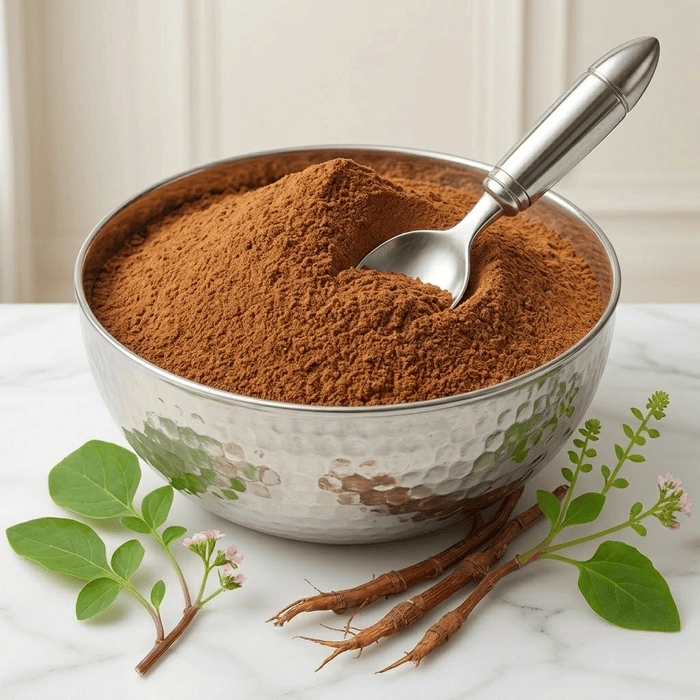
Product Name: Moringa Gond Powder
Botanical Name : Moringa oleifera
Form : Powder
Moringa Gond Powder is a botanical gum ingredient obtained from the naturally occurring gum exudate of the bark of Moringa oleifera. The collected gum is dried and finely processed to produce a convenient powdered material for commercial formulation and manufacturing applications. The Moringa tree is traditionally recognized in India by names including Drumstick Tree, Sahjan, Munaga and Sajna.
Unlike moringa leaf powder, this ingredient is derived from the gum associated with the bark of the tree. Its commercial relevance is linked to naturally occurring polysaccharides, mucilage, water-absorbing capacity, binding functionality, thickening behavior and stabilizing characteristics. These properties make it suitable for evaluation by manufacturers working across several industries.
The material has a history of traditional use in Ayurveda, Unani practices and household nutritional preparations. In modern commercial development, it has attracted interest as a plant-derived functional ingredient for pharmaceutical, nutraceutical, food, cosmetic, personal-care and selected industrial formulations.
For international procurement, the ingredient can be supplied from India to professional buyers seeking botanical raw materials for manufacturing, wholesale distribution, formulation development, private-label programs and other B2B applications.
The botanical source of the material is Moringa oleifera, a plant native to the Indian subcontinent and now cultivated across different tropical and subtropical regions. The tree is widely recognized for its traditional importance and commercial versatility.
The raw material used for this product is the bark gum exudate. After collection, the gum is dried under suitable conditions and processed into a fine powder. This creates a practical format for manufacturers who require a dry botanical material that can be incorporated into appropriate formulation systems.
The distinction between gum-derived material and leaf-derived moringa ingredients is important for international buyers because their physical properties, applications and technical functions are different.
For commercial procurement, correct botanical identification provides the foundation for specification development. Buyers can evaluate the material according to their intended application, desired functional characteristics, packaging requirements and destination-market standards.
The scientific identity associated with the product is Moringa oleifera. Commercial and traditional terminology may vary between regions and industries.
Common terminology includes Moringa Gum, Sahjan Gond, Munaga Gum and Sajna Gum. Some buyers may also search for Moringa Gum Powder when looking for the powdered form of this plant-derived exudate.
Using botanical terminology together with commercial product terminology can make procurement discussions clearer, particularly when international buyers are comparing botanical ingredients from different origins.
For importers and manufacturers, the botanical name, plant part used and physical form should ideally be included in technical product information to reduce confusion between different Moringa-derived materials.
The principal functional interest in Moringa gum comes from its naturally occurring polysaccharides and mucilaginous components. These constituents influence how the material interacts with water and contribute to its viscosity, binding and stabilizing behavior.
Reported polysaccharide-related components include:
The material is also associated with reported mineral constituents such as calcium, magnesium, potassium, iron, zinc and phosphorus, along with vitamins including A, C, E and B-complex vitamins.
Other reported constituents include quercetin, kaempferol, chlorogenic acid, polyphenols, phenolic compounds, proteins, amino acids, mucilage, dietary fiber and antioxidant compounds.
The actual composition may vary depending on botanical source, collection, drying, processing and other production conditions. Therefore, international manufacturers should evaluate every commercial material against their own technical specifications.
One of the important functional characteristics associated with Moringa gum is its ability to interact with water.
This characteristic can make the powdered material relevant to formulation systems where viscosity, consistency, binding or physical stability are important. Depending on the formulation, manufacturers can investigate the ingredient as a natural thickening component or functional botanical polymer.
Its performance is not identical in every product because the final result depends on formulation composition, processing conditions, concentration and interaction with other ingredients.
For this reason, professional manufacturers generally conduct application-specific trials before incorporating a new botanical gum into commercial production.
The gum's natural polymeric behavior provides additional interest for formulation development. It can be evaluated for binding, stabilization and emulsifying functionality in suitable product systems.
These properties are particularly relevant to industries that use functional excipients or natural formulation aids. Pharmaceutical manufacturers may investigate its binding and disintegration behavior, while food businesses may examine its thickening and stabilization characteristics.
Cosmetic developers can similarly assess the material according to the texture and stability requirements of their formulations.
The product should therefore be considered as a functional botanical raw material whose final performance depends on the application in which it is used.
Moringa gum has generated interest within pharmaceutical formulation because of its natural binding and polymer characteristics.
Potential areas of evaluation include:
A manufacturer searching for Moringa Gond Powder for pharmaceutical industry applications may evaluate the material according to its functional behavior, physical specifications and compatibility with the intended formulation.
Research has investigated Moringa gum as a natural polymer for controlled-release and delivery systems. Such research remains an area of continuing development, and commercial pharmaceutical use should be supported by appropriate technical validation and regulatory compliance.
For professional pharmaceutical procurement, buyers may require specific parameters related to purity, moisture, particle characteristics, functionality, microbiological quality and other application-specific requirements.
The term natural excipient refers to a material used within a formulation to provide a supporting technical function rather than serving as the primary active ingredient.
Because Moringa gum possesses binding and polymeric characteristics, it has attracted interest as a possible plant-derived excipient.
A buyer researching Moringa Gum manufacturer for pharmaceutical applications may therefore be interested in technical consistency rather than only botanical origin.
Commercial suitability should be determined through formulation trials, stability evaluation and the quality requirements applicable to the final pharmaceutical product.
The botanical origin of the gum also creates opportunities for evaluation within nutraceutical manufacturing.
Potential formats include:
A company looking for Moringa Gond Powder for nutraceutical industry requirements can assess the ingredient according to the intended formulation and target market.
Traditional use has associated Moringa gum with nutritional and seasonal preparations. However, commercial supplement manufacturers should distinguish traditional use from scientifically established health outcomes and formulate product claims according to applicable regulations.
Moringa gum can be evaluated in food systems where a plant-derived thickening, stabilizing or emulsifying component is required.
Potential food-related applications include:
Manufacturers searching for Moringa Gond Powder for food industry applications may assess water-binding behavior, texture contribution, stability and compatibility with the finished formulation.
Traditional Indian food preparations have incorporated Moringa gum into nutritional recipes, including laddoo-style preparations and seasonal foods intended to provide nourishment and warmth.
Commercial food use should be evaluated according to the applicable food-grade specification and destination-country requirements.
The functional properties of Moringa gum make it relevant to cosmetic formulation as a plant-derived binding, thickening or stabilizing component.
Potential applications include:
A manufacturer evaluating Moringa Gond Powder for cosmetics may consider the ingredient according to the required texture, consistency, formulation stability and compatibility with other raw materials.
Moringa-derived botanical materials are also associated with traditional skin and hair-care practices. Finished cosmetic performance should always be determined through formulation development and testing.
Moringa gum can be considered in personal-care systems where a plant-derived functional ingredient is desired.
Potential concepts include:
For a buyer searching for Moringa Gond Powder for personal care, the key evaluation areas may include powder characteristics, water interaction, binding behavior, formulation compatibility and stability.
Manufacturers can determine the most suitable concentration and processing conditions through their own product-development procedures.
The material can also be investigated for selected hair-care and scalp-care preparations.
Potential applications include:
Its natural binding and formulation characteristics may allow it to work alongside other suitable botanical materials.
A manufacturer interested in Moringa Gum Powder for hair care can evaluate the ingredient according to the desired texture, application method and final product format.
Moringa gum has a long association with traditional Indian household preparations. It has historically been incorporated into nutritional foods and seasonal recipes.
Traditional applications described for the material include nutritional preparations intended to support general nourishment, strength and seasonal wellness. It has also been used in preparations associated with postnatal nutrition.
These traditional uses provide historical context but should not automatically be interpreted as clinically established medical effects.
For international product manufacturers, traditional positioning can be considered separately from regulated health claims.
Scientific investigation has examined several potential biological characteristics of Moringa gum.
Laboratory and animal research has produced findings of interest, but additional human research is required before many potential health effects can be firmly established.
Therefore, international manufacturers should avoid converting preliminary research findings into guaranteed therapeutic claims.
The presence of naturally occurring compounds such as quercetin, kaempferol, chlorogenic acid, polyphenols and phenolic compounds has contributed to scientific interest in Moringa gum.
These compounds are among the plant-derived constituents associated with antioxidant research.
For a company investigating Moringa Gond Powder antioxidant potential, the relevant evaluation should focus on the actual material specification and applicable testing rather than assuming identical constituent levels across different batches.
Moringa gum has potential beyond food, health and personal-care applications.
Its natural binding and film-forming characteristics have attracted interest in textile-related processing. It may be evaluated as a finishing or binding material for selected applications.
An industrial buyer searching for Moringa Gum Powder for textile processing may assess the product according to its binding behavior, consistency and compatibility with the specific manufacturing process.
Commercial suitability should be established through technical trials.
The polymeric characteristics of Moringa gum have also been associated with paper manufacturing.
The material can be evaluated as a natural sizing or binding component in selected paper-processing systems.
For industrial procurement, the required technical parameters may differ substantially from those needed by food, cosmetic or nutraceutical manufacturers. Buyers should therefore specify the intended industrial application when requesting product information.
The polysaccharide-rich character of Moringa gum has generated interest in natural polymer research.
Areas being investigated include:
A research organization looking for Moringa Gond natural polymer may evaluate the material based on its polysaccharide characteristics and functional behavior.
These applications remain subject to laboratory investigation and technical validation. Commercial use in specialized biomedical systems requires appropriate research, testing and regulatory approval.
From a B2B procurement perspective, the material offers several characteristics that can be relevant to manufacturers:
The material is also described as vegan-friendly and naturally gluten-free in the supplied product information. Such characteristics should be confirmed against the actual commercial specification when required for a finished product.
Bulk Moringa Gond Powder supplier requirements are generally associated with businesses purchasing larger quantities for manufacturing, distribution or formulation development.
Potential B2B customers include:
Bulk purchasing can be structured around required volume, packaging configuration, application and destination.
For recurring procurement, buyers may also establish a technical specification to help maintain consistency between purchase cycles.
India is closely associated with Moringa oleifera and its traditional botanical use. This makes India a relevant sourcing location for international businesses searching for Moringa-derived raw materials.
A company searching for a Moringa Gond Powder supplier from India can evaluate the source according to botanical identity, processing practices, consistency, packaging and export capability.
For professional buyers, the origin of the raw material is only one part of procurement. Technical suitability, commercial quantity, documentation and destination requirements should also be considered.
Businesses seeking a Moringa Gond Powder manufacturer in India may include importers, pharmaceutical companies, nutraceutical manufacturers, cosmetic businesses, food processors, herbal-product companies and industrial ingredient distributors.
Commercial sourcing can be discussed according to:
This approach allows the product to be evaluated according to the actual needs of the importing organization.
For overseas procurement, a Moringa Gond Powder exporter from India can serve businesses looking for Indian-origin botanical materials for manufacturing and distribution.
The product can be considered for international B2B markets including the USA, UK, Germany, Europe, UAE, Australia, South Korea and other destinations, subject to applicable import regulations and buyer-specific requirements.
International customers may use the material for manufacturing, distribution, formulation development or private-label programs depending on their business needs.
Companies developing an India to USA Moringa Gond Powder supply program can specify their intended use, order quantity, packaging requirements and documentation expectations.
Potential buyers may include nutraceutical manufacturers, pharmaceutical businesses, cosmetic companies, food processors and botanical distributors.
The final specification should be aligned with the importing company's product category and applicable US market requirements.
An India to UK Moringa Gond Powder supply arrangement can be considered by importers, distributors and manufacturers sourcing plant-derived gum ingredients from India.
Commercial discussions may cover quantity, packaging, technical information and intended application.
The importing organization should determine the regulatory and documentation requirements applicable to its finished product category.
A business planning India to Germany Moringa Gond Powder supply can establish requirements around product specification, packaging, quantity and destination.
For wider European procurement, India to Europe Moringa Gond Powder supply can support businesses sourcing botanical raw materials for pharmaceutical, food, cosmetic, nutraceutical, herbal or industrial applications.
Because requirements can vary according to the country and final application, buyers should provide complete procurement details before confirming a commercial order.
Businesses seeking an India to UAE Moringa Gond Powder supply can evaluate the ingredient for herbal, nutraceutical, cosmetic, food and industrial applications.
Importers and distributors may establish their own packaging and documentation requirements according to their downstream customers and local market conditions.
An India to Australia Moringa Gond Powder supply program can be developed according to the requirements of Australian importers, manufacturers and distributors.
Similarly, businesses developing an India to South Korea Moringa Gond Powder supply can specify application, quantity, packaging and destination requirements before commercial procurement.
For every export destination, the importing organization remains responsible for confirming applicable local requirements.
Wholesale Moringa Gond Powder supplier requirements may come from botanical distributors, importers and companies purchasing the material for further commercial distribution.
The ingredient can also be considered for private-label programs involving:
Private-label buyers may specify packaging, labeling, quantity and product requirements according to their target market.
Before placing a bulk order, professional buyers can evaluate:
For specialized applications, additional technical testing may be required.
A clear procurement specification helps both the buyer and supplier understand the expected material characteristics and reduces uncertainty during repeat sourcing.
Correct storage helps preserve the physical condition and functional characteristics of Moringa Gond Powder.
The product should be maintained in a clean, cool and dry environment and protected from:
Airtight packaging is recommended, and the package should be resealed after handling.
The supplied product information identifies approximately 15°C–25°C as an ideal storage range.
Under appropriate storage conditions, the source indicates an approximate shelf life of 24–36 months. Once opened, use within approximately 6–12 months is suggested for optimum quality.
Possible signs of deterioration include:
Actual shelf stability should be considered according to packaging, storage environment and the applicable product specification.
Companies intending to buy Moringa Gond Powder in bulk can provide basic procurement information such as:
This information is particularly useful when a buyer requires recurring shipments or a customized supply arrangement.
For manufacturers, defining the application at the beginning of the procurement process can help ensure that the selected raw material is appropriate for the intended formulation.
The commercial importance of this material comes from the combination of botanical origin and functional properties.
A pharmaceutical company may investigate its excipient and polymer behavior. A food manufacturer may examine its thickening and stabilization characteristics. A cosmetic company may assess its binding and texture contribution.
A nutraceutical business can evaluate it for suitable botanical formulations, while industrial manufacturers can investigate its use in textile or paper-related processes.
This diversity does not mean the same specification is appropriate for every industry. Instead, it highlights why application-specific procurement is important.
It is a fine powdered botanical gum obtained from the natural gum exudate associated with the bark of Moringa oleifera.
No. Moringa Gond Powder is derived from the gum exudate of the bark, whereas Moringa leaf powder is produced from the leaves.
The Moringa tree is commonly known as Drumstick Tree, Sahjan, Munaga and Sajna. The gum is also referred to as Moringa Gum, Sahjan Gond, Munaga Gum and Sajna Gum.
Its naturally occurring polysaccharides are associated with water absorption, thickening, binding, emulsifying and stabilizing functionality.
It can be evaluated for tablet binding, disintegration, controlled-release research and natural excipient development, subject to technical validation.
Yes. It can be evaluated for suitable thickening, stabilization, emulsification and traditional food applications according to applicable food requirements.
Cosmetic manufacturers can evaluate it for suitable creams, lotions, masks, serums, botanical preparations and other formulation systems.
The material can be evaluated for textile finishing, paper sizing and binding, natural polymer research and selected biomedical investigations.
Yes. International B2B buyers can evaluate Indian-origin supply according to their quantity, application, packaging and destination requirements.
International sourcing can include markets such as the USA, UK, Germany, Europe, UAE, Australia, South Korea and other destinations, subject to applicable import and product requirements.
Moringa Gond Powder combines the traditional identity of Moringa oleifera with functional characteristics that have generated interest across modern manufacturing sectors. Its polysaccharide-rich composition, water interaction, binding ability, thickening behavior, emulsifying potential and natural polymer characteristics make it a versatile botanical raw material.
Its applications extend from herbal and nutritional preparations to pharmaceutical excipient research, nutraceutical development, food processing, cosmetics, personal care, textile applications, paper manufacturing and natural polymer research.
For international B2B buyers, sourcing from India can be structured according to the exact commercial requirement. Importers, distributors, manufacturers and private-label businesses can specify their desired quantity, intended use, packaging preference, destination country and technical requirements.
Vardhman Nutrition Co. supplies this Moringa-derived botanical gum for international B2B procurement and export-oriented applications. The product can be evaluated for bulk manufacturing, wholesale distribution, formulation development and private-label programs according to the buyer's requirements.
The focus remains on supplying a product-specific botanical ingredient for professional buyers looking for an India-origin source for their international manufacturing and distribution requirements.







.webp)
.webp)
.webp)
.webp)
.webp)
.webp)
.webp)
.webp)
.webp)
.webp)
.webp)
.webp)

.webp)