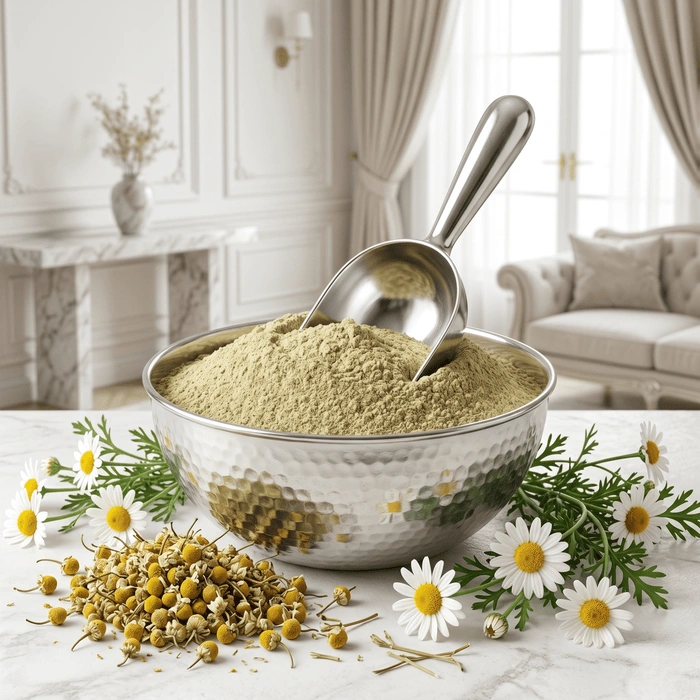
Chamomile Flower Powder Manufacturer & Global B2B Exporter from India
Vardhman Nutrition Co. is an India-based Chamomile Flower Powder Manufacturer in India, supplying India-origin botanical ingredients to international B2B buyers. Our product is prepared from carefully handled dried chamomile flowers and processed into a convenient powder suitable for herbal, nutraceutical, cosmetic, tea, food, wellness and botanical product development.
Chamomile is commonly recognized as German Chamomile and botanically identified as Matricaria chamomilla L., with Matricaria recutita L. used as a synonym. It belongs to the Asteraceae family, and flowers or flower heads are the principal plant material used in chamomile preparations.
Our export-oriented supply approach serves importers, wholesalers, distributors, herbal manufacturers, tea businesses, nutraceutical companies, cosmetic manufacturers and private-label product developers seeking commercial quantities from India.
India-Origin German Chamomile for Commercial Sourcing
German Chamomile Flower Powder is a dry botanical material obtained by drying suitable flowers or flower heads and processing them into a fine form. For international procurement, clearly identifying the botanical species and plant part helps buyers establish an accurate raw-material specification.
The product may also be described commercially as Chamomile Powder, Chamomile Herbal Powder, Chamomile Botanical Powder, or Dried Chamomile Flower Powder, depending on the buyer's terminology and intended application.
Its dry format makes it convenient for businesses involved in formulation, blending, further processing and botanical product development.
Botanical Reference for Overseas Buyers
- Common Name: Chamomile
- English Name: German Chamomile
- Botanical Name: Matricaria chamomilla L.
- Synonym: Matricaria recutita L.
- Family: Asteraceae
- Plant Part: Flowers / Flower Heads
- Product Form: Powder
- Origin: India
This identification is important because the word chamomile can be used commercially for more than one botanical species. Buyers requiring authenticated material can include species, plant part and product form in their purchase specification.
Natural Profile of the Flower Material
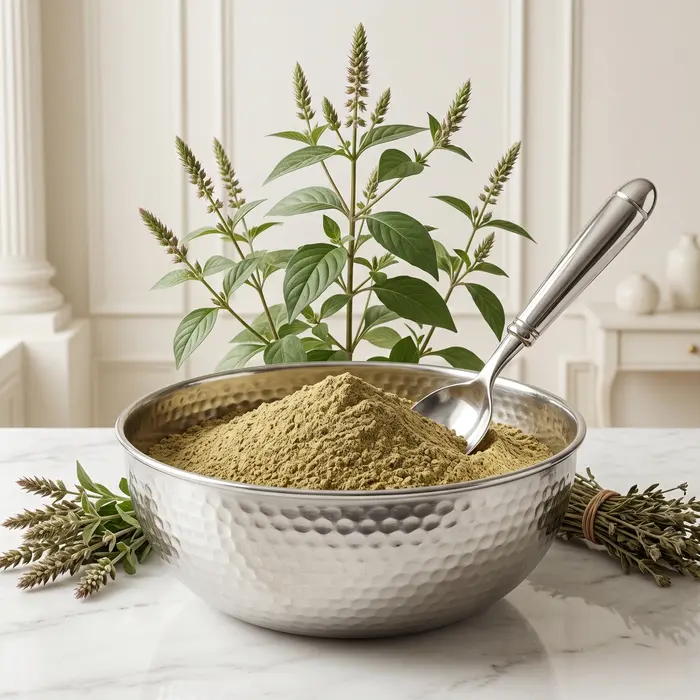
Chamomile flowers are known for their delicate floral character and naturally occurring botanical constituents. After drying and grinding, the resulting material generally has a light yellow to golden appearance with a characteristic floral aroma.
The final colour, aroma, texture and particle characteristics can vary according to flower quality, maturity, harvesting conditions, drying practices, geographical origin and storage.
An Indian Chamomile Flower Powder specification can therefore be customized around the buyer's desired appearance, aroma, moisture level and powder fineness.
Phytochemical Character of Matricaria Flowers
Scientific literature has reported various naturally occurring compounds in chamomile. Important constituents associated with the botanical include:
- Apigenin
- Luteolin
- Quercetin
- Bisabolol-related compounds
- Chamazulene-related constituents
- Polyphenolic compounds
- Other naturally occurring plant components
The natural phytochemical profile is not necessarily identical from one batch to another. Cultivation conditions, geographic origin, maturity, harvest timing, drying and storage may influence the composition.
Where a buyer requires a defined analytical marker or specific testing profile, the requirement should be established before commercial confirmation.
Traditional Heritage and Botanical Applications
Chamomile has a long history in traditional herbal practices and botanical infusion products. Its flowers are particularly associated with tea preparations and have also been used in various plant-based wellness and personal-care concepts.
Traditional background provides useful context for product development, but it should not automatically be presented as proof of a therapeutic effect. Finished-product claims and labeling must be established according to the regulations of the destination market.
This approach is especially relevant for businesses developing products containing a Chamomile Flower Herbal Ingredient.
Herbal Tea and Botanical Beverage Development
Chamomile flowers have a strong association with herbal infusions, making the powdered botanical material relevant to selected tea and beverage concepts.
Potential commercial applications include:
- Herbal tea blends
- Botanical infusion products
- Wellness beverages
- Plant-based drink formulations
- Customized herbal blends
Manufacturers can specify powder fineness, botanical identity, packaging and quality parameters according to their production system.
Nutraceutical and Wellness Product Development
Businesses involved in botanical and nutraceutical manufacturing may evaluate chamomile as part of suitable plant-based formulations.
Chamomile Powder for Nutraceutical Applications can be considered for botanical blends, wellness-oriented products and other permitted formulations.
Depending on the project, importers may request information regarding:
- Botanical identity
- Plant part
- Moisture
- Particle size
- Microbiological parameters
- Heavy metals
- Pesticide residues
- Packaging
- Documentation
The suitability of the raw material depends on the finished product design and regulatory requirements of the destination country.
Cosmetic, Hair and Personal-Care Formulations
Chamomile is also relevant to businesses developing botanical cosmetic and personal-care products.
Potential applications include:
- Face masks
- Creams
- Lotions
- Soaps
- Face washes
- Shampoos
- Conditioners
- Hair masks
- Botanical personal-care preparations
The powdered flower material can be evaluated as a dry botanical ingredient within appropriate formulations.
Any product claim relating to skin appearance, soothing properties or other functional benefits should be supported by the finished-product manufacturer and comply with applicable regulations.
Research and Botanical Development Potential
Chamomile has attracted scientific interest because of its naturally occurring flavonoids, terpenoid-related substances and other phytochemicals. Apigenin, quercetin, luteolin, bisabolol-related compounds and chamazulene-related constituents have been discussed in scientific literature.
Research has investigated various aspects of chamomile, including antioxidant activity, relaxation-related applications, digestive comfort, sleep-related use and skin-related applications. Such research should be distinguished from guaranteed medical outcomes.
For B2B customers, the material can also serve as an authenticated botanical raw material for product-development studies and formulation research.
Commercial Processing of Dried Chamomile Flowers
The preparation of a consistent powdered ingredient involves careful handling of the original flower material.
A general processing sequence may include:
Flower Selection → Cleaning → Drying → Inspection → Grinding → Sieving → Quality Evaluation → Packaging
Moisture control is an important consideration during drying because excessive moisture can affect the physical condition and storage behaviour of botanical material.
Processing parameters may be discussed according to the buyer's required fineness, intended use and quality specification.
Quality Specification for Importers
International buyers can establish a product specification covering relevant physical and analytical parameters.
Depending on the application, requirements may include:
- Correct botanical identity
- Appropriate plant part
- Natural appearance
- Characteristic aroma
- Moisture specification
- Particle size
- Foreign matter
- Microbiological parameters
- Heavy-metal requirements
- Pesticide-residue testing
- Buyer-specific analytical criteria
- Packaging requirements
Botanical authentication is particularly important where multiple chamomile species are commercially available.
Bulk Supply for International Businesses
Vardhman Nutrition Co. provides Bulk Chamomile Flower Powder Supplier from India services for commercial buyers requiring larger quantities.
The supply model is intended for businesses involved in:
- Manufacturing
- Importing
- Wholesale distribution
- Further processing
- Botanical formulation
- Tea production
- Cosmetic development
- Nutraceutical manufacturing
- Private-label projects
Commercial quantity, packaging and technical specifications can be discussed according to the buyer's requirement.
Wholesale and B2B Procurement
As a Wholesale Chamomile Powder Supplier, Vardhman Nutrition Co. focuses on international business requirements rather than domestic retail positioning.
A Chamomile Flower Powder B2B Supplier can support importers, ingredient traders, distributors, herbal businesses, tea companies, cosmetic manufacturers and botanical product developers.
Buyers can provide their quantity, intended application, destination, testing requirements and preferred packaging to begin a commercial discussion.
Chamomile Powder Exporter from India for Global Markets
Vardhman Nutrition Co. is an India-based Chamomile Flower Powder Exporter from India serving international B2B sourcing requirements.
Potential export destinations include:
- USA
- UK
- Europe
- Germany
- UAE
- Australia
- South Korea
- Other international markets
Destination-country requirements can differ according to whether the material is intended for food, tea, cosmetics, nutraceuticals, herbal products or another permitted use.
Export Supply for USA, UK and European Buyers
Businesses searching for Chamomile Powder for USA import can discuss India-origin material according to their technical requirements and intended application.
Companies looking for Chamomile Powder for UK or European procurement can provide their desired botanical specification, quality parameters, packaging and documentation requirements.
For Germany, a Chamomile Powder Supplier for Germany can be evaluated according to quantity, application and destination-specific requirements.
The buyer remains responsible for confirming the applicable import and finished-product regulations in the destination country.
UAE, Australia and South Korea Supply
International businesses in the UAE, Australia and South Korea can enquire about Chamomile Powder from India for suitable commercial applications.
To facilitate quotation and specification review, buyers should share:
- Required quantity
- Botanical identity
- Flower specification
- Powder fineness
- Intended application
- Packaging preference
- Destination
- Testing requirements
- Documentation requirements
This information helps establish a clear commercial reference before dispatch.
Private-Label Chamomile Ingredient Supply
Businesses developing their own tea, wellness, cosmetic, herbal or botanical brands may consider Chamomile Powder for Private Label projects.
Customized requirements may cover:
- Botanical identity
- Flower quality
- Powder fineness
- Testing
- Packaging
- Quantity
- Documentation
- Destination-market requirements
Private-label supply is subject to product feasibility and agreed specifications.
Packaging and Storage for Export Shipments
Packaging can be selected according to quantity, transportation conditions, storage duration and buyer preference.
For maintaining product quality, the powder should generally be protected from:
- Excessive moisture
- Direct sunlight
- Excessive heat
- Contamination
- Strong odours
- Improper handling
A clean, dry and suitable storage environment is recommended. Airtight packaging can help reduce exposure to environmental moisture and external contaminants.
The general storage guidance supplied for this product recommends approximately 15°C to 25°C, with protection from light and humidity.
Shelf-Life Considerations
Under suitable storage conditions, the supplied product information indicates a general shelf-life range of approximately 12 to 24 months.
After opening, use within approximately 6 to 12 months can help retain the intended physical and aromatic characteristics.
Storage conditions, packaging integrity, moisture exposure and handling can influence stability. Material showing visible mold, unusual odour, excessive clumping or significant deterioration should not be used.
The final commercial shelf-life should be confirmed according to the agreed specification and packaging conditions.
Why Choose an India-Based Chamomile Supplier?
India has an established botanical raw-material sector, providing international businesses with access to India-origin herbal ingredients.
Vardhman Nutrition Co. focuses on:
- India-origin botanical supply
- International B2B procurement
- Bulk commercial requirements
- Product-specific specifications
- Export-oriented packaging
- Botanical identification
- Buyer-focused communication
Our approach is designed for overseas businesses looking for a reliable India-origin botanical ingredient partner.
Buy Chamomile Flower Powder in Bulk from India
Businesses looking to Buy Chamomile Flower Powder in Bulk can contact Vardhman Nutrition Co. with their commercial requirements.
Please provide:
- Required quantity
- Product specification
- Intended application
- Powder fineness
- Packaging preference
- Destination country
- Testing requirements
- Documentation requirements
We can review the requirement and discuss suitable international B2B supply options.
Frequently Asked Questions
What is Chamomile Flower Powder?
It is a powdered botanical ingredient prepared from dried chamomile flowers or flower heads, commonly associated with German Chamomile, Matricaria chamomilla L.
What is the botanical synonym?
Matricaria recutita L. is a commonly used synonym for Matricaria chamomilla L.
Which part of chamomile is used?
Flowers and flower heads are the principal botanical material used for chamomile preparations.
Is whole flower powder the same as chamomile extract?
No. Dried flower powder and concentrated or standardized extracts are different products with different processing methods and specifications.
Can international buyers purchase this material in commercial quantities?
Yes. Vardhman Nutrition Co. supplies India-origin chamomile material for international B2B requirements.
Can the powder specification be customized?
Buyers can discuss botanical identity, fineness, testing parameters, packaging, quantity and destination-specific requirements.
Contact Vardhman Nutrition Co. for Chamomile Export Supply
If you are searching for a Chamomile Flower Powder Supplier, Chamomile Powder Manufacturer, Chamomile Powder Exporter, Wholesale Chamomile Flower Powder Supplier, or an India-origin botanical ingredient partner, contact Vardhman Nutrition Co. with your commercial requirement.
Please share:
- Required quantity
- Product specification
- Intended application
- Powder fineness
- Packaging preference
- Destination country
- Testing requirements
- Documentation requirements
We can review the requirement and discuss suitable commercial supply options for your international business.
Vardhman Nutrition Co.
Chamomile Flower Powder Manufacturer & Global B2B Exporter from India
Bulk Botanical Ingredient Supply Worldwide
Product Information Disclaimer
This page provides general botanical and commercial information. Traditional uses and scientific research should not be interpreted as guaranteed therapeutic outcomes. The suitability of Chamomile Flower Powder for any finished product depends on formulation, testing, intended use and applicable regulations. Buyers and finished-product manufacturers are responsible for confirming destination-country requirements and ensuring compliant labeling, claims and applications.




.webp)


.webp)
.webp)
.webp)
.webp)
.webp)
.webp)
.webp)
.webp)
.webp)
.webp)
.webp)
.webp)
.webp)