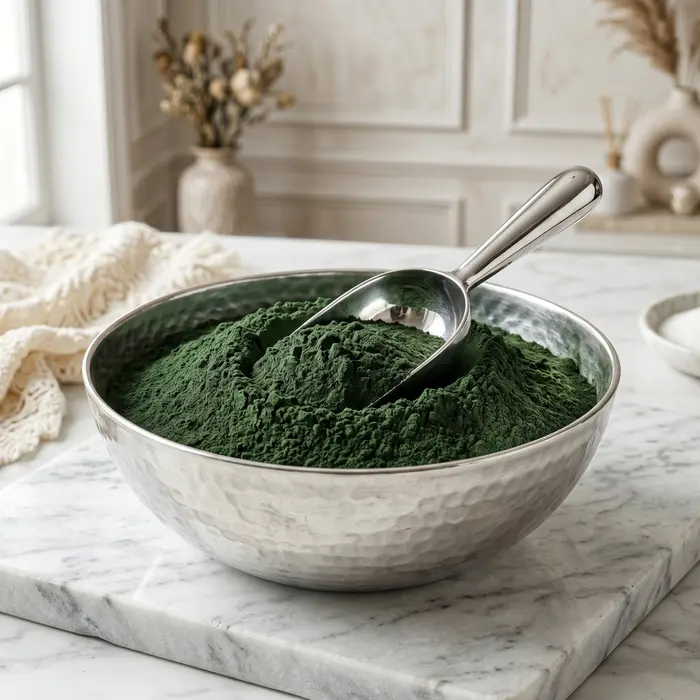
Product Name: Spirulina Powder
Botanical Name : Arthrospira platensis
Form : Powder
Spirulina Powder is a naturally derived blue-green microalgal ingredient obtained from Arthrospira platensis, a member of the cyanobacteria group. It is widely recognized for its nutrient-dense composition and characteristic blue-green appearance, making it an interesting raw material for food, nutraceutical, dietary supplement, sports nutrition, wellness and selected cosmetic formulations.
The distinctive colour of Spirulina is naturally associated with pigments including phycocyanin and chlorophyll. Once processed into powder, the material becomes convenient for manufacturers and formulation companies that require an algae-based nutritional ingredient for further product development.
Vardhman Nutrition Co. is an India-based Spirulina Powder Manufacturer, Spirulina Powder Supplier and Spirulina Powder Exporter from India, serving professional B2B buyers seeking commercial quantities for manufacturing and distribution. The ingredient can be considered by nutraceutical businesses, supplement brands, functional food companies, sports nutrition manufacturers, cosmetic formulators, animal nutrition companies, ingredient distributors, wholesalers, importers and private-label businesses.
The company's India-origin supply model supports buyers looking for natural ingredients from India for domestic formulation as well as international commercial requirements.
Spirulina Powder is produced from Arthrospira platensis, a blue-green microalga associated with alkaline and mineral-rich aquatic environments. The organism is cultivated under controlled conditions before its biomass is harvested and processed.
Unlike conventional botanical powders obtained from roots, leaves or seeds, Spirulina represents a microalgal raw material. Its distinctive biological origin contributes to its unique colour, nutritional characteristics and formulation possibilities.
The dried material is transformed into a powder that can be conveniently incorporated into nutritional mixes, supplement preparations, functional food products and selected personal-care concepts.
For commercial procurement, buyers should consider the exact product specification supplied for their intended application because composition can vary according to cultivation, processing and storage conditions.
A typical Spirulina Powder has a characteristic blue-green appearance associated with its natural pigment profile. Phycocyanin is particularly important to this visual identity, while chlorophyll and carotenoids contribute to the broader pigment composition.
The material may have a characteristic algae-like aroma and flavour profile. These sensory properties are relevant when manufacturers formulate beverages, powders, food blends or other finished products in which Spirulina forms a noticeable part of the ingredient system.
For product developers, colour, odour, particle characteristics and compatibility with the finished formulation are useful considerations before commercial production.
The production of commercial Spirulina involves several controlled stages intended to produce a consistent ingredient suitable for further processing.
Depending on the production system and agreed requirements, the preparation may involve:
Each stage can influence the physical and nutritional characteristics of the finished material. Careful moisture control is particularly important because excess moisture can affect storage stability.
The final product should therefore be evaluated according to the agreed technical specification rather than relying solely on general descriptions of Spirulina.
The commercial interest in Spirulina is strongly connected with its naturally occurring nutritional components. Product information indicates that Spirulina may contain a substantial proportion of protein by dry weight, together with amino acids, minerals, fatty acids, pigments and other naturally occurring compounds.
The supplied product information indicates an approximate protein range of 55–70% by dry weight, although actual values may differ according to the batch and should be confirmed through the relevant Certificate of Analysis or specification.
This composition gives formulation businesses an opportunity to incorporate an algae-derived nutritional ingredient into a variety of modern product concepts.
Protein is one of the most recognised nutritional characteristics of Spirulina. The ingredient can provide a broad range of amino acids that are relevant to plant-based nutritional formulation.
Naturally occurring amino acids may include:
This amino-acid composition makes Spirulina relevant to nutrition companies developing protein-containing blends, wellness powders and plant-oriented nutritional products.
The precise nutritional contribution of a finished product depends on the complete formulation, inclusion level and serving size rather than on the raw material alone.
Spirulina may contain several vitamins and minerals naturally associated with its nutritional profile.
The vitamin-related components described in the supplied information include beta-carotene, vitamins B1, B2, B3, B5, B6, E and K. Mineral constituents may include iron, calcium, magnesium, zinc, potassium, phosphorus, selenium, copper and manganese.
The actual concentration of individual nutrients can vary according to cultivation and processing. Manufacturers requiring exact nutritional values should therefore review the applicable analytical documentation for the supplied batch.
The natural pigment profile is one of the most distinctive features of Spirulina. Phycocyanin is closely associated with its blue-green appearance, while chlorophyll and carotenoids contribute to its broader pigment composition.
Other naturally occurring constituents may include:
These constituents have also contributed to the scientific and commercial interest surrounding Spirulina as a nutritional ingredient.
In addition to proteins and micronutrients, Spirulina contains naturally occurring fatty acids. Gamma-linolenic acid, Omega-3 fatty acids and Omega-6 fatty acids are among the components associated with its nutritional profile.
Their presence adds another dimension to the ingredient's nutritional composition and contributes to its relevance for manufacturers developing comprehensive nutrition products.
As with other nutrients, the actual amount present should be established from the relevant product analysis where quantitative formulation decisions are required.
Spirulina Powder for Dietary Supplements can be incorporated into powdered nutrition products, capsules, tablets and blended formulations.
Manufacturers may combine it with other compatible ingredients to create nutritional products designed around protein, micronutrients, plant-based ingredients or broader wellness concepts.
The final dosage, product positioning, labelling and permitted claims should be determined according to the finished formula and the regulatory framework applicable in the intended market.
Spirulina Powder for Nutraceutical Applications can be used as a raw material in nutritional and wellness-oriented formulations.
Potential product formats include:
Its convenient powder format allows it to be blended with other ingredients according to the manufacturing process and final product concept.
The term superfood is commonly associated with nutrient-dense food ingredients, and Spirulina has gained considerable commercial recognition in this category.
Manufacturers can explore Spirulina Powder in superfood blends, nutritional powders, smoothie preparations and other wellness-oriented food concepts.
The natural blue-green colour can become a distinctive visual element in finished products. However, product developers should evaluate sensory characteristics carefully because the natural flavour and colour of Spirulina can influence the final formulation.
Spirulina Powder for Functional Food applications can be considered by food businesses developing products with added nutritional positioning.
Potential categories include:
The ingredient can be combined with compatible plant-based materials according to the product developer's objectives.
For commercial food production, the permitted use of Spirulina and any associated claims should always be assessed according to the destination market and relevant food regulations.
Spirulina can be explored in selected beverage concepts because its powder format allows it to be dispersed or blended into appropriate liquid formulations.
Possible applications include:
Its naturally occurring blue-green colour can create a distinctive appearance. Formulators should assess dispersibility, taste, colour stability and interaction with other ingredients before finalising the product.
Spirulina Powder for Sports Nutrition is relevant to manufacturers developing plant-based nutrition products for active consumers.
The protein and amino-acid profile can support formulation concepts such as:
Finished-product benefits and performance claims should not be assumed solely from the presence of Spirulina. Product positioning should be based on the complete formula and appropriate scientific and regulatory assessment.
As an algae-derived ingredient, Spirulina can fit into a variety of plant-oriented nutritional formulations.
It may be considered for:
Its plant-based profile and convenient powder form make it suitable for businesses seeking alternative nutritional ingredients for modern consumer product development.
Spirulina Powder for Cosmetics can be considered in selected personal-care products where algae-derived ingredients are appropriate.
Potential applications include:
The final use should be determined according to formulation compatibility, product stability, intended claims and cosmetic regulations in the target market.
Spirulina Powder for Animal Feed can be evaluated for selected nutritional formulations involving fish, shrimp, pets and other specialised feed applications.
Potential uses may include:
The suitable inclusion rate and specification should be established according to animal species, feed formulation and applicable regulatory requirements.
Spirulina has been investigated for a variety of nutritional and biological characteristics. Research has examined antioxidant activity, immune response, lipid metabolism, blood pressure, glucose metabolism, nutritional status, exercise-related applications and liver-related areas.
Phycocyanin and other naturally occurring compounds are among the constituents contributing to scientific interest.
However, research outcomes can differ according to product composition, study design, dosage and participant characteristics. Many observations remain preliminary or require additional well-designed human studies.
Therefore, Spirulina is best presented as a nutrient-rich ingredient for product development rather than as a replacement for medical treatment.
Natural pigments and phenolic compounds in Spirulina have generated interest in antioxidant research. Phycocyanin, carotenoids and other constituents have been studied for their potential role in mechanisms associated with oxidative processes.
Laboratory and preclinical research provides useful information about these properties, but laboratory findings should not automatically be interpreted as established clinical outcomes.
For manufacturers, the distinction between ingredient characteristics and finished-product health claims is particularly important when preparing commercial marketing material.
Scientific investigations have examined Spirulina in relation to cholesterol and lipid profiles, blood pressure, blood glucose, immune response, nutritional status and other health-related areas.
Some studies have reported encouraging findings, while other areas require more extensive research. Differences in product composition can also affect research results.
Consequently, businesses developing Spirulina-containing products should use evidence-based and regulation-compliant language when describing the finished product.
Professional procurement requires more than simply selecting an ingredient by name. Buyers should evaluate whether the material is appropriate for their specific manufacturing process and destination market.
Important considerations can include:
The final specification should be mutually agreed between buyer and supplier before commercial procurement.
B2B buyers may require technical and commercial documentation to support their internal quality systems and import procedures.
Depending on the order and destination, documentation may include:
Vardhman Nutrition Co. indicates that relevant technical documentation and reports can be discussed according to customer requirements.
Businesses purchasing Spirulina for manufacturing may require quantities substantially larger than retail packs. Bulk procurement is therefore relevant to ingredient distributors, supplement manufacturers, food companies, sports nutrition brands, cosmetic businesses and other professional users.
As a Bulk Spirulina Powder Supplier, Vardhman Nutrition Co. supports enquiries involving commercial quantities.
Buyers can provide their expected order volume, application, packaging preference and delivery destination so that the sourcing requirement can be evaluated.
Spirulina Powder Wholesale sourcing can be useful for ingredient distributors and businesses purchasing the material for further commercial distribution.
Wholesale requirements may involve regular shipment schedules, recurring procurement or larger quantity programs.
A buyer can provide expected annual demand or shipment-wise requirements to help establish an appropriate supply arrangement.
A Spirulina Powder B2B Supplier serves businesses that purchase the ingredient for manufacturing, formulation or distribution rather than primarily for individual retail consumption.
Potential B2B customers include:
The commercial supply model can be discussed according to product application and procurement requirements.
Businesses searching for a Spirulina Powder Manufacturer in India can evaluate sourcing according to quantity, product specification, application and destination requirements.
Vardhman Nutrition Co. provides an India-based sourcing option for businesses seeking Spirulina for further manufacturing and distribution.
The product specification can be discussed according to the buyer's intended use, required quantity and destination-market requirements.
As a Spirulina Powder Supplier from India, Vardhman Nutrition Co. supports commercial enquiries from importers, manufacturers, distributors and wholesalers.
Relevant India-origin search phrases include:
These keywords clearly establish the geographical origin of the product while targeting buyers searching for commercial sourcing options.
Vardhman Nutrition Co. operates as a Spirulina Powder Exporter from India for international B2B buyers.
Businesses searching for an Indian Spirulina Powder Exporter can discuss bulk requirements, product specifications, packaging, documentation and shipment arrangements according to their procurement plans.
Additional relevant terms include:
This India-origin positioning is important for accurately communicating the direction of international supply.
For American importers and manufacturers, Spirulina Powder Export from India to USA can be considered for suitable commercial applications.
Buyers in the United States can discuss quantity, packaging, technical requirements and documentation according to their intended use.
A natural search phrase for this market is Spirulina Powder Exporter from India for USA Buyers, which clearly identifies India as the source and the USA as the destination.
Businesses sourcing Spirulina for the United Kingdom can enquire about Spirulina Powder Export from India to UK.
Commercial discussions can cover order volume, packaging requirements, technical specifications and documents needed for the intended application.
The product can be evaluated by UK importers, distributors, supplement businesses and manufacturers seeking an India-origin ingredient supply option.
For European buyers, Spirulina Powder Export from India to Europe can support commercial sourcing requirements for suitable food, nutraceutical, supplement and wellness applications.
European importers can communicate their destination-specific requirements before order confirmation so that product documentation and specifications can be reviewed appropriately.
German manufacturers and ingredient importers can explore Spirulina Powder Export from India to Germany according to their commercial requirements.
Quantity, specification, packaging and documentation can be discussed before shipment. Buyers should communicate any destination-specific technical or regulatory requirements during the procurement process.
For businesses in the United Arab Emirates, Spirulina Powder Export from India to UAE can be considered for nutritional, food, supplement and related commercial applications.
Importers and distributors can provide their required quantity, packaging format and documentation needs for evaluation.
Australian businesses can enquire about Spirulina Powder Export from India to Australia for commercial manufacturing and distribution requirements.
Product specification, quantity, packaging and destination-specific documentation can be discussed before shipment according to the buyer's procurement plan.
For South Korean importers and manufacturers, Spirulina Powder Export from India to South Korea can be evaluated according to application, specification and commercial quantity.
Buyers can provide their intended use, required volume, packaging preference and technical requirements so that the supply arrangement can be considered.
Spirulina Powder Private Label supply can be relevant to businesses developing their own branded nutritional products.
Private-label companies may use Spirulina as a raw material in finished nutritional powders, wellness products and other suitable formulations after conducting appropriate formulation and regulatory evaluation.
Potential commercial requirements may include:
Packaging and labelling should be finalized according to the destination market and applicable regulations.
Companies developing specialised products may also consider Spirulina Powder OEM sourcing.
OEM discussions can involve the intended product category, raw-material specification, commercial quantity, packaging requirements and other agreed parameters.
The precise scope of an OEM project should be established according to actual manufacturing capabilities and the buyer's final product requirements.
Packaging plays an important role in protecting Spirulina Powder during storage, transportation and international distribution.
Suitable packaging should help minimise exposure to:
Packaging arrangements can be discussed according to order quantity, transport route, storage conditions and buyer requirements.
Spirulina Powder should be kept in a sealed, airtight package in a cool, clean and dry environment.
General handling recommendations include:
The supplied product information indicates approximately 15°C–25°C as a suitable general storage range. Refrigeration may be useful in hot climates when appropriate for the product and packaging.
Under normal sealed storage conditions, the supplied product information indicates an approximate shelf life of 24–36 months.
Actual stability can depend on packaging, oxygen exposure, moisture, temperature, light and handling frequency.
After opening, the product should be kept tightly sealed and protected from environmental exposure. Buyers should follow the manufacturer's stated storage and shelf-life instructions for the specific supplied material.
Regular inspection can help identify possible quality changes during storage.
The powder should be evaluated if there is:
A substantial change from the characteristic blue-green appearance toward brown or another unusual colour may indicate that the material requires further evaluation before use.
India provides an established base for natural ingredient sourcing and international B2B trade. For businesses seeking algae-derived nutritional ingredients, sourcing from an India-based manufacturer and exporter can provide a direct origin route for commercial procurement.
For international buyers, the important consideration is not simply the country of supply but whether the supplier can support the required specification, quantity, packaging and documentation.
An India-origin sourcing model can therefore be relevant to businesses searching specifically for Spirulina Powder Supplier from India or Spirulina Powder Exporter from India.
Vardhman Nutrition Co. is an India-based manufacturer and global B2B exporter of natural ingredients, including Essential Oils, Cold Pressed Virgin Seed Oils and Botanical Herbs. Established in 2018, the company supports professional customers such as importers, distributors, manufacturers, private-label businesses, cosmetic companies, nutraceutical brands and pharmaceutical companies.
For businesses searching for a Spirulina Powder Manufacturer, Spirulina Powder Supplier or Spirulina Powder Exporter from India, the company provides an India-based commercial sourcing option.
The supplied company information states an ISO 9001:2015 quality-management certification and a quality-oriented approach covering product handling and packaging.
Spirulina can be relevant to multiple industries, but successful product development depends on selecting the right application and specification.
Food manufacturers may focus on sensory compatibility and regulatory suitability. Supplement businesses may prioritise nutritional characteristics and documentation. Cosmetic companies may assess formulation stability and appearance. Animal nutrition businesses may focus on feed-specific requirements.
This application-specific approach helps manufacturers use Spirulina appropriately rather than treating every product category in the same way.
The combination of protein, amino acids, minerals, natural pigments and other constituents makes Spirulina a versatile raw material for modern formulation businesses.
Its powder form supports easy incorporation into suitable dry blends and other product systems. The distinctive blue-green colour can also contribute to the visual identity of some finished products.
For manufacturers, the commercial value of Spirulina lies in its ability to serve different formulation concepts while remaining a recognisable algae-derived nutritional ingredient.
Before placing a bulk order, businesses should define the intended application, quantity, technical requirements, packaging preference and destination country.
This information allows the supplier and buyer to establish a clear commercial specification.
Professional procurement can therefore begin with a practical requirement such as:
This process is particularly useful for importers and manufacturers managing international ingredient sourcing.
Businesses looking for Spirulina Powder Bulk, Bulk Spirulina Powder Supplier, Spirulina Powder Wholesale, Spirulina Powder B2B Supplier, Spirulina Powder Wholesale Supplier from India or Spirulina Powder B2B Exporter from India can discuss their commercial requirements with Vardhman Nutrition Co.
The product is relevant to businesses involved in nutraceuticals, dietary supplements, functional foods, sports nutrition, wellness products, cosmetics and selected animal nutrition applications.
Quantity, packaging, application and technical requirements can be reviewed according to the buyer's procurement plan.
For a commercial enquiry, buyers can share their required quantity, intended application, preferred specification, packaging requirements and destination country.
Providing these details helps in evaluating the appropriate supply arrangement and documentation requirements.
Vardhman Nutrition Co. supports international businesses searching for Spirulina Powder Manufacturer in India, Spirulina Powder Supplier from India, Spirulina Powder Exporter from India, Bulk Spirulina Powder Supplier from India and commercial B2B sourcing.
If your business requires Spirulina Powder from India for nutritional formulation, food manufacturing, supplement production, private-label development or distribution, you can submit your requirement for commercial evaluation.







.webp)




.webp)
.webp)
.webp)
.webp)
.webp)
.webp)
.webp)
.webp)
.webp)
.webp)
.webp)
.webp)

.webp)